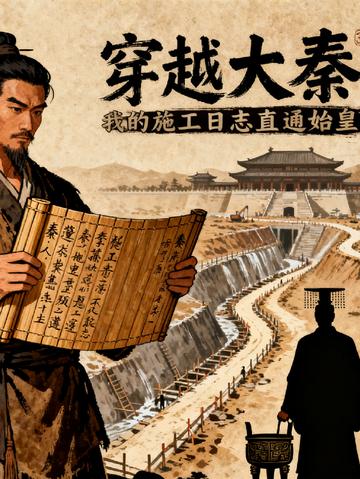
Wang Lei, a modern civil engineer who survived sudden death, opened his eyes and became a civilian husband at the Jingshui construction site in the 13th year of the Qin Dynasty.
Looking at the "tofu dregs" canal and dam with unstable foundation and ridiculously steep slope in front of him, he couldn't bear it - if this were in modern times, the supervisor would have scolded the construction team until they had to rework!
Relying on the slope stabilization principle and the simple cementitious material formula in his mind, he first rescued and repaired canals and dams, and then used modern infrastructure construction ideas to improve them: rammed earth mixed with aggregate to enhance the strength, building arch bridges to connect rivers, building cities to protect borders...
From being suspected by the pavilion chief, to being recommended by the engineers, and then to alarming the First Emperor, Wang Lei used a ram and a picture to take the infrastructure of the Qin Dynasty to a new high: the fertile fields of Guanzhong are crisscrossed by canals, the six kingdoms are connected by roads, and the Great Wall in northern Xinjiang is impregnable.
The Qin army followed the roads he built and swept across the world, using the tools he built to expand its territory. The well water delivered by Ajaan warmed the stomach, and the good news from the Western Regions ignited the soul - who said civil servants can only draw blueprints? He wants to use infrastructure to build a glorious and prosperous age in Da Qin that will unify the world and then expand into the distance!
In the end, Hu Hai became the emperor.