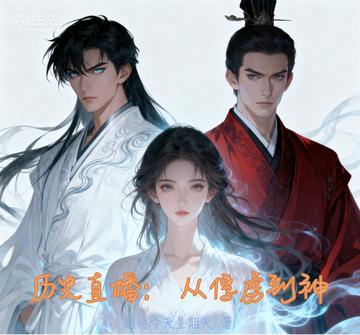
[After the gods stepped into the human realm and were targeted by crazy monarchs and ministers!
Emperor Wu of the Han Dynasty entangled her with immortality: either share eternity or die together!
Huo Qubing was chasing God with passion: Look at me, look at me, just look at me!
Ayan:......
————————————————————
Excerpt from "Volume 2: Huo Qubing Discussing the Art of War"
"Li Gan's father, Li Guang, was a veteran of three dynasties. This time against King Zuo Xian, his 4,000 cavalry were suddenly encountered by 40,000 enemy troops. It was the Li family's bravery that could sustain them until reinforcements arrived. But in a battlefield battle, physical courage alone is far from enough."
"The biggest taboo in war is to use one's own shortcomings to attack the enemy's strong points. The Xiongnu always respects the left, and King Zuo Xian's troops are the elite of the main force. Li Guang led only 4,000 cavalry, but faced a powerful force of 40,000 head-on. This taboo was violated."
"Don't talk about bad luck! On the battlefield, life and death depend on a thread. The responsibility of a general is to do everything possible to turn unfavorable risks into favorable opportunities!"
"The first opportunity for transformation lies in intelligence. As a general, you must spread your eyes and ears widely to detect the enemy's true condition and observe the enemy's movements."
"Li Guangxing's army went against the grain. He often relied on intuition and regarded intelligence and reconnaissance as a last resort. He was also very self-centered in running the army. A little was enough, and a lot would lead to chaos. This sudden encounter with the main force of King Zuoxian may seem unexpected, but in fact it is inseparable from his omissions in intelligence and lack of prejudgment."
"It is impossible for an army of 40,000 to appear out of thin air. If we had detected it earlier, or avoided its edge, or set up an ambush for a surprise attack, how could we have fallen into such a dangerous situation!"
"Victory is victory, defeat is defeat." At this point, Huo Qubing's words had no room for change, "How is it tragic to die on the battlefield? If bravery fails to win victory, it is useless."
Reader comments
Breathtaking!
This is the biggest feeling I have about this book after reading the latest chapter "Lu Hongzong's Theory"!
The author's theoretical level, thorough understanding of life, and profound writing skills make this book very profound and make the people in this book, Huo Qubing and Lu Hong, come alive, and they are very, very amazing and brilliant!
I have read many novels about Huo Qubing, but either he was reduced to a weak male protagonist in love, or he was reduced to a foil for male porn. None of them could describe Huo Qubing's true style.
The talent of a young man has never been seen in five thousand years.
To be honest, I disagree with many of Sima Qian's descriptions of him and have many doubts.
Just say that they thought that he led the most elite soldiers and could achieve the great cause of sealing the wolf and living in Xu. They really took it for granted.
In this book, the author describes Huo Qubing's military thoughts. I really like the chapter "Huo Qubing discusses the art of war". I have read it over and over again. That is Huo Qubing and the reason for his success!
The author wrote about Huo Qubing in a big way without downplaying his problems. His arrogance and his disregard for the suffering of the people were clearly expressed.
And Lu Hong, this character, his profound interpretation of Confucianism, Taoism and Law really makes me admire the author. Those written dialogues cannot be written without a certain theoretical accumulation, especially Lu Hong's explanation of etiquette and analysis of Emperor Wu of the Han Dynasty, which are very penetrating!
There is also the portrayal of Emperor Wu of the Han Dynasty. Liu Che here is definitely a very powerful, very deep, very mean and unkind emperor, a real feudal and historical emperor, not a conventional fun-loving person. This really makes me like it.
Finally, I want to say that I like your work very much, starting from the Zhao Zhao part. I hope that after you finish this one, you can also finish that one. Such a clear and powerful Zhao Zhao deserves an ending.
And, a small suggestion, I think you should put the second volume in front, the second volume is so well written...[][][][][]
To say it looks good would be a bit superficial...
The content is full of thoughts about life
I am very happy to come across such a book. I marvel at the author's thoughts. I am particularly touched by one sentence in it. Let me talk about my own opinions:
"Let the book become the cornerstone under your feet, and use it to enhance your horizons so that you can see farther. Instead of letting the words become a tangled rope, trapped in the trajectory of the predecessors."
This is not only the wisdom of our reading, but also the key to the development of civilization. Books carrying wisdom and experience can be a ladder leading to a broad vision, or they can become a prison for thinking. The tragedy of Zhao Kuo's "paper talk" is the historical fact that the art of war has degenerated from a cornerstone into a rope. Those who are trapped by words, like the prisoners in Plato's cave, mistake the projection on the wall for the totality of reality.
Huo Qubing's thinking from a practical perspective is the essence of critical thinking—wisdom of insight. We are not satisfied with knowing "how to do it", but also ask "why we do it" and "can we do it better". In those ancient times when business was regarded as a wrong path and Confucianism was regarded as the norm, it was a kind of transcendence to dare to tear apart the "orthodox" dogma, inquire deeply and ask questions continuously.
Only in this way could he awaken the dormant fighting power in those books and achieve such a dazzling feat. Not only is it the best among the three armies, but it is also the best in the present and past!
Reflecting on this made me think more. At the moment when AI is just beginning to emerge, padding is no longer a simple accumulation of knowledge, or "how many ways to write the word fennel for fennel beans", but a higher and faster cognitive reshaping and thinking expansion.
The vitality of knowledge is not only passed down, but also transcended. In particular, when algorithm push continues to facilitate our knowledge acquisition, and when massive amounts of information are instantly judged and refined by AI, critical thinking will become the last resort to resist the ropes of thought.
Only by untying the ropes of words and stepping on the footsteps of our predecessors, rather than crawling under their footsteps, can the torch of the human spirit continue to be passed on.
I would like to take this as my exclamation for this book.
Breathtaking! This is the biggest feeling I have about this book after reading the latest chapter "Lu Hongzong's Theory"! The author's theoretical level, thorough understanding of life, and profound writing skills make this book very profound and make the people in this book, Huo Qubing and Lu Hong, come alive, and they are very, very amazing and brilliant! I have read many novels about Huo Qubing, but either he was reduced to a weak male protagonist in love, or he was reduced to a foil for male porn. None of them could describe Huo Qubing's true style. The talent of a young man has never been seen in five thousand years. To be honest, I disagree with many of Sima Qian's descriptions of him and have many doubts. Just say that they thought that he led the most elite soldiers and could achieve the great cause of sealing the wolf and living in Xu. They really took it for granted. In this book, the author describes Huo Qubing's military thoughts. I really like the chapter "Huo Qubing discusses the art of war". I have read it over and over again. That is Huo Qubing and the reason for his success! The author wrote about Huo Qubing in a big way without downplaying his problems. His arrogance and his disregard for the suffering of the people were clearly expressed. And Lu Hong, this character, his profound interpretation of Confucianism, Taoism and Law really makes me admire the author. Those written dialogues cannot be written without a certain theoretical accumulation, especially Lu Hong's explanation of etiquette and analysis of Emperor Wu of the Han Dynasty, which are very penetrating! There is also the portrayal of Emperor Wu of the Han Dynasty. Liu Che here is definitely a very powerful, very deep, very mean and unkind emperor, a real feudal and historical emperor, not a conventional fun-loving person. This really makes me like it. Finally, I want to say that I like your work very much, starting from the Zhao Zhao part. I hope that after you finish this one, you can also finish that one. Such a clear and powerful Zhao Zhao deserves an ending. And, a small suggestion, I think you should put the second volume in front, the second volume is so well written...[][][][][]
To say it looks good would be a bit superficial... The content is full of thoughts about life I am very happy to come across such a book. I marvel at the author's thoughts. I am particularly touched by one sentence in it. Let me talk about my own opinions: "Let the book become the cornerstone under your feet, and use it to enhance your horizons so that you can see farther. Instead of letting the words become a tangled rope, trapped in the trajectory of the predecessors." This is not only the wisdom of our reading, but also the key to the development of civilization. Books carrying wisdom and experience can be a ladder leading to a broad vision, or they can become a prison for thinking. The tragedy of Zhao Kuo's "paper talk" is the historical fact that the art of war has degenerated from a cornerstone into a rope. Those who are trapped by words, like the prisoners in Plato's cave, mistake the projection on the wall for the totality of reality. Huo Qubing's thinking from a practical perspective is the essence of critical thinking—wisdom of insight. We are not satisfied with knowing "how to do it", but also ask "why we do it" and "can we do it better". In those ancient times when business was regarded as a wrong path and Confucianism was regarded as the norm, it was a kind of transcendence to dare to tear apart the "orthodox" dogma, inquire deeply and ask questions continuously. Only in this way could he awaken the dormant fighting power in those books and achieve such a dazzling feat. Not only is it the best among the three armies, but it is also the best in the present and past! Reflecting on this made me think more. At the moment when AI is just beginning to emerge, padding is no longer a simple accumulation of knowledge, or "how many ways to write the word fennel for fennel beans", but a higher and faster cognitive reshaping and thinking expansion. The vitality of knowledge is not only passed down, but also transcended. In particular, when algorithm push continues to facilitate our knowledge acquisition, and when massive amounts of information are instantly judged and refined by AI, critical thinking will become the last resort to resist the ropes of thought. Only by untying the ropes of words and stepping on the footsteps of our predecessors, rather than crawling under their footsteps, can the torch of the human spirit continue to be passed on. I would like to take this as my exclamation for this book.