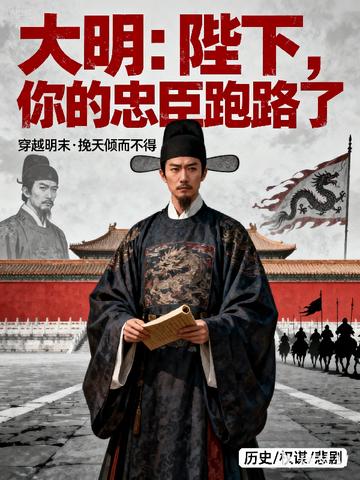
After transmigrating to the late Ming, Li Dan hopes to use his modern knowledge to save the dying empire and prop up the crumbling Ming dynasty. But the emperor is suspicious, the court is riven by factional strife, treacherous officials conspire against him, and enemy cavalry threatens from beyond the borders. For his unwavering loyalty, he is repaid with suspicion and stripped of power. His close friend Yuan Chonghuan dies a brutal death, and the reform edict he devoted his life to is revoked.
At his most disillusioned, he finally sees the truth: this rotten dynasty is not worth dying for! If the Ming has no hope left, he'll set sail and carve out a new world elsewhere!
He gathers refugees, reclaims deserted islands, trains a new army, and builds mighty ships.
He defeats the Dutch, takes control of the South Seas, opens trade, and establishes a new dynasty.
In the South Seas, he builds an entirely new Huaxia regime, one that leaves internal power struggles behind, encourages scientific and technological innovation, and combines the strengths of East and West.
From a loyal minister devoted to saving the Ming to a warlord who reigns overseas.
What he protects is no longer the realm of one family, but the spark of an entire civilization.
See how Li Dan cuts a path through the raging storm of the end times, preserving one final refuge for Huaxia and ushering in a magnificent age of maritime conquest!
When gathering at the school grounds, you don't have to wear armor. Why do you have to take it off only when you receive your salary, and why do you want to see the artillerymen facing you? Is that distance enough for you to hit? Who would carry an inkstone with them? After the gunner is hit, can he also light the gun powder chamber? Don't have too many coincidences. Can you think of some reasonable cause-and-effect relationships?
It's not a good book if you don't rebel in the late Ming Dynasty. I feel bad when I read it. It's a good book but it's not suitable for me.
This book is pretty good