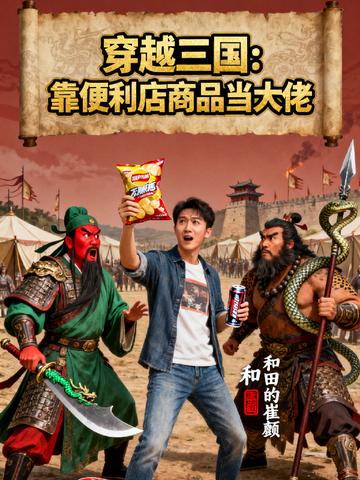
The cold wind of the late Eastern Han Dynasty came with the smell of blood. He was tied to the black stone of the Yellow Turban Altar, the firewood crackling under him, and the surrounding believers were roaring to "sacrifice him to Huang Tian."
At the critical moment, the binding alert sounded in my mind, and the ordinary products on the shelf instantly transformed into life-saving weapons: I took out a lighter and lit the "divine fire", which made the Yellow Turban believers kneel down and kowtow; I threw three cans of iced Coke, and the carbonic acid explosion overturned the surrounding soldiers and opened the escape route; even the expired rice balls left in the refrigerator caused the chasing cavalry to collectively suffer from diarrhea, and they collapsed in the reeds and cursed.
Since then, Wang Xiaoming's Three Kingdoms Road has completely gone astray: he relied on a Swiss Army knife to chop thorns and wooden spears to build a refugee shelter in the barren mountains; he fed the hungry people with compressed biscuits and gained the first group of devoted followers; he used dark chocolate as "hard currency" in exchange for Orion intelligence and merchant access, and even made passing Liu Beijun soldiers jealous.
But how can it be so easy to be a boss? Zhang Bao stared at his "immortal food" and pursued him. Cao Cao sent scouts to find out the "source of the strange items." Even the remnant spirit of Shennong attached to the grains urged him to "use convenience store supplies to save the hungry people all over the world." What's even more outrageous is that the system always gives out counter-routine tasks: adding laxatives to official porridge cured the plague, using instant noodle soup base as a "march supplement" to deceive the support of soldiers, using lollipops to coax the young princes to defuse wars.