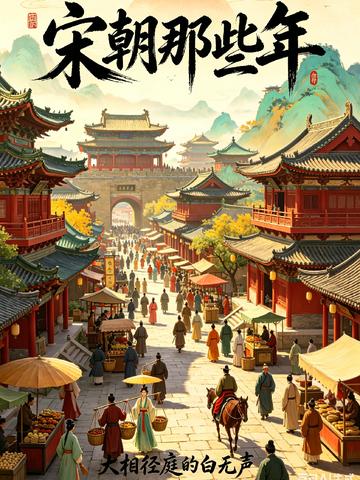
Those Years of Song Dynasty
宋朝那些年
- Status
- Completed
- Length
- 352k Words
- Genre
- Historical
- Subgenre
- Historical & Ancient
- Audience
- Male
- Updated
- 8mo ago
- Source
- Fanqie
Stats
48Reads
74Chapters
2Listens
375Reads · all time
Tags
Synopsis
Reader comments
In booklists 3
The Book of Support!
I want to read a book similar to "The End of Ten Days". Best book in the box👀
6.3MViews407Books7dUpdated


Must Reply to the Five-Star Book Review When Commenting on Each Other
I want to read a book like "Baby, My Mission is to Love You All My Life". Come all, come here. Authors without traffic come here to review and help each other. Come and review a book.
184.8kViews194Books18hUpdated
Short Stories, Short Stories, There Is a Shortage of Books
I want to see content similar to "If the rich man pisses off the god in his dream, let's destroy him". @Strategypai
98.7kViews680Books4dUpdated
This book outlines the panoramic view of the Song Dynasty in the style of a novel. From the fireworks in the streets to the intrigues in the temples, each story is like a window, revealing the warmth and texture of the dynasty. The author uses vivid characters to connect the economic context, cultural character and military situation. The book has a sense of historical significance without losing the interest of the story. The 350,000-word page contains a profound insight into the times. It is a sincere work worth savoring!
The very different value expression of Bai Wusheng's "Those Years in the Song Dynasty" is mainly reflected in three unique and novel dimensions, which breaks out of the inherent framework of traditional Song history narrative and has both warmth and depth: 1. Achieve the civilian-oriented narrative of Song history: break away from the traditional perspective of "emperors and generals dominate history", and use the "silent majority" ignored by official history such as legal practitioners, craftsmen, merchants, refugees, etc. As the core of the narrative, and use "individual destiny to reflect the texture of the times". The characters are not deified or labeled, so that the cold history is filled with the warmth of people's livelihood and individual struggles. 2. Construct a view of Song Dynasty civilization that is not a grand narrative: avoid the single perspective of "literati elegance", use "the fragrance of ink" as a clue, connect the inheritance of carving, epigraphy, printing and other skills to show the protection of civilization by literati, craftsmen, businessmen and other groups, break the stereotype of "Song Dynasty civilization = literati civilization", and reveal the inclusiveness and inheritance code of Song Dynasty civilization of "the elegance of temples + the essence of the market + pragmatic wisdom". 3. Dialectically interpret the system of the Song Dynasty to demonstrate the depth of thought: Breaking away from the binary opposition of "criticism or beautification", taking the "contradiction" of the system as the entry point, it not only objectively presents the positive effects and cruel limitations of national policies such as "advocating culture and suppressing military force", but also transforms cold institutional terms into warm plot conflicts through the fate of multi-class characters. It dialectically views the complexity and inevitability of historical institutions, which is different from impetuous interpretations of similar works. In addition, the work adheres to the creative concept of "history is the bones and stories are the flesh", and does not reduce history to the background of the story, but allows the story to serve the historical expression. It not only retains the historical weight, but also has the readability of the novel. At the same time, it provides new inspiration for the creation of similar historical novels to "break out of routines, focus on details and ordinary people".
The author attempts to present the politics, economy, culture, society and other aspects of the Song Dynasty through the stories of multiple individuals or families, explaining that the rise and fall of the dynasty and the fate of individuals and families are a community that shares weal and woe! Volume 7: Thoughts after reading "Bianjing Rhymes" The sound of the law lasts for thousands of years, and justice illuminates the mountains and rivers The most touching magic of "Bianjing Rhythms" is that it makes the two cold words "law" grow warmth and strength. It is not a suspended political novel, but a long song of the rule of law in the Song Dynasty with perseverance as the melody and people's livelihood as the background - from the dark clouds in Bianjing in the third year of Jiayou's reign to the warm sun in front of the Law Pavilion, Wen Yanzhi, Xie Qingyan, and Liu Atang, a group of "torch bearers", used their half-life obsession and blood to carry out the "law is not noble" His faith, from his father's legacy and the inscriptions of his prison sentence, was forged into a code of law that protects all living beings. The characters in the novel have never been "deified", but are full of pyrotechnic reality. Wen Yanzhi's perseverance began with a private revenge to clear his father's wrong, but in the tears of river workers, the doubts of the barbarians, and the hunger of the refugees, he understood that the ultimate meaning of the law is not revenge, but to let every common people "Live with dignity"; behind Xie Qingyan's uprightness, there are hidden the ups and downs of the female imperial examination, the pain of an old injury on her left arm, and the regret of not being able to let her father witness the consummation; Liu Atang has grown from a widowed daughter hiding behind her father to a disseminator who dares to debate with scholars and can integrate autopsy and law. In her courage, she always carries her father's original intention of "doing autopsy without lying". Even the supporting characters are vivid and three-dimensional: the old jailer Zhang Zhong has defended injustice for ten years, the leader of the barbarian tribe Mu Kun has peace in mind, and the law student Su Ming has passed down the legacy. They are not tools to promote the plot, but witnesses to the implementation of the law, and they are the simplest footnotes of "justice." In terms of narrative, the novel follows the vein of "case breakthrough - global extension - system implementation", progressing layer by layer but relaxed. From the absurd "twenty catties of copper fine" in the murder case of Lu Gongchuo's slaves, to the resolution of the salt dispute between the barbarians in Kuizhou, to the resettlement of the refugees in Jiangnan during the disaster years, each case is not an isolated game, but the practice of the law from "paper" to "civilian". The final promulgation of the "New Edition of the Laws of the Song Dynasty" is not the end of the story, but the root of the concept of "rule of law" - it allows the people to put forward opinions, sets up a government-citizen consensus mechanism, and is revised every three years, so that the law is no longer a gift from the court, but a justice jointly established by all living beings. What's even more rare is that the novel faces up to the truth that there is no perfection in the world: late farewells, unfinished testimonies, and scars that can never be erased. These regrets do not weaken the power of perseverance, but make the choice of "a disciplined heart" more profound - the law cannot eliminate all pain, but it can become armor against injustice, so that people in the future will avoid detours. After closing the volume, the bluestone road in Bianjing City, the smoke from the saltworks in Kuizhou, and the "Law Source Wall" of the Law Pavilion are still lingering in front of my eyes. This novel tells the story of law in the Song Dynasty, but it expresses mankind's eternal pursuit of justice: the rule of law is never a miracle achieved overnight, but a bright light that countless people use their original intentions as fuel and perseverance as fire, step by step. It tells us that the law is not a cold statute, but justice that lives in the hearts of the people; it is not a top-down gift from a few people, but the result of the joint protection of all sentient beings. Thousands of years ago, the laws carved by Wen Yanzhi in prison and the formulas preached in the countryside turned into "laws" that traveled through time and space; thousands of years later, the courage and perseverance of this "torch bearer" can still illuminate people's hearts - because no matter how the times change, the desire for justice and the protection of people's livelihood will always be the most precious foundation of mankind. This is the most profound echo that "Bianjing Rhythm" leaves readers: Justice may be late, but as long as someone is willing to hold up a torch and move forward, the light of law will eventually shine through the mountains and rivers.
The story is novel and unique. It tells things about the Song Dynasty through different things, allowing us to understand it more clearly.
A very good series of stories. I'll comment in detail later.
It is rare to see such a calm and objective Song Dynasty literature, without sensationalism or routines. Only by reading it slowly can you understand the sadness and tenderness hidden behind that era.