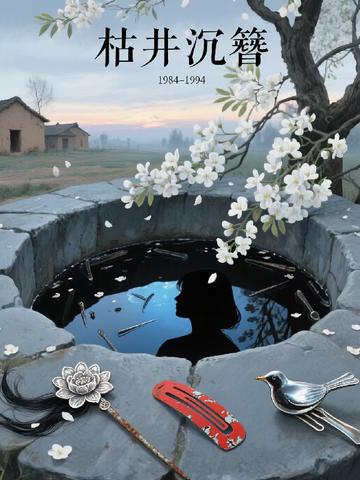
Synopsis of the story of "A Hairpin Sinking in a Dry Well"
core themes
Using the custom of "throwing hairpins in dry wells" in Chenjia Village from 1984 to 1994 as a carrier, this article connects the historical secrets of the village and the entanglements of human nature, explores the relationship between "superstition and truth", "trauma and reconciliation" and "material and emotion", and finally settles on "peace of mind is not something you seek, but the courage to face the past".
Volume One: Huaiying Suspense (1984-1987): Frequent occurrences of strange things and the beginning of secrets
Core conflict: The village's custom of "throwing hairpins to seek safety" contrasts with the successive bizarre events. Granny Wang's abnormal behavior and the mystery of the dry well create suspense.
Key chapters and events
Cicadas and Red Hairpins (Summer 1984)
Introduction to the background: Chenjiacun's custom of "throwing hairpins in dry wells" (women throw hairpins/hairpins to pray for peace), the geographical symbols of the old locust tree at the entrance of the village and the dry well behind the village.
Strange things first appeared: Xiulian threw a red plastic hairpin for the crying child, and Nianwa discovered the long blood-stained hair under the roots of the locust tree and the blue cloth rag (stained with black mud from a dry well) that Aunt Li's family lost last year.
Characters appear: 8-year-old Nian Wa (observer's perspective), mysterious Granny Wang (the only one who doesn't throw away the hairpin, implying that "there is no god in the well"), cowardly Xiulian, and the shrewd wife of the village party secretary.
Fingerprints along the well (1984 Xia Yu)
The suspense escalates: after the rain, a woman's fingerprints facing down appear on the edge of a dry well (nails embedded in the bark of a locust tree), and Nianwa smells the scent of rouge wafting from the well (which is consistent with the scent of rouge of the village party secretary's daughter-in-law).
Grandma Wang's warning: Prevent Nianwa and Shuanzi from approaching the dry well, revealing that "the dry well is an old well from the Wanli period and has been filled in again and again.