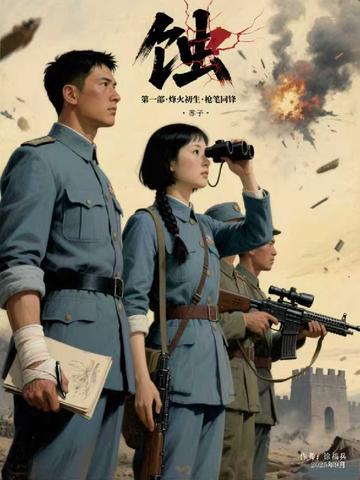
Synopsis of The Erosion, Part One
In the spring of 1938, the artillery of the Battle of Xuzhou tears through the land of southern Shandong. Lu Chen, an artistic soldier, takes his drawing board onto the battlefield. His charcoal pencil becomes a blade, capturing in his sketchbook the Sichuan Army's ironclad defense of Teng County, the cries of the counterattack at Taierzhuang, and the sparks of hope during the breakout from Xuzhou. On the retreat, he encounters half of a military identification tag engraved with "122, Lu." It is a keepsake left behind by his father, who disappeared ten years earlier. It awakens him from a mere "observer" into a "protector." From then on, rifle and pencil in hand, he shoulders the duty of defending his homeland amid the flames of war.
On a rainy night in the Shanghai International Settlement, he bonds with Song Qing, a refugee student, over a painting titled Erosion. In it, a mother shielding her child from artillery fire gazes out with steely resolve, reflecting the belief they share: art should not gloss over suffering, but etch the pain of war and the warmth of humanity into the soul. A raid by the Japanese military police shatters their brief cooperation. Lu Chen stays behind to cover the others and is wounded, while Song Qing heads north to Yan'an with the painting Witness and half of the military tag. Through intensive training, Song Qing grows into a special operations commander, forming the Lightning Squad and mastering both sniping and intelligence work.
Amid the smoke of the southern Shandong base area, they meet again. Lu Chen has already built an armed resistance force, using the strategy of besieging a stronghold to lure out reinforcements and eliminate Japanese garrisons. At the Battle of Xiqiangyu, he joins forces with the Nationalist Army to deal the enemy a crushing blow. Song Qing leads the special operations squad to one victory after another, shooting down enemy aircraft with a sniper rifle and blowing up a Japanese mustard gas base. They witness the tragic sacrifice of the eighty-two martyrs of Liuzhuang and carry on General Peng Xuefeng's legacy. Amid the flames and bloodshed of the anti-cleansing campaigns and the Battle of Cheqiao, they bring the spirit of Witness to life: in the painting, soldiers and civilians charge forward as one; beyond it, they hold their ground amid a hail of bullets.
The historical value of the first part of Eclipse is presented: From the perspective of historical value, this work is of great significance. It not only records important battles and historical events in the Anti-Japanese War, but also deeply demonstrates the impact of the war on people's lives and spirits. Through the description of war scenes and the fate of characters, readers can intuitively feel the hardships and hardships during the Anti-Japanese War, as well as the huge sacrifices and efforts made by Chinese soldiers and civilians for national liberation. At the same time, the work also reflects various contradictions and problems in society at that time, provides vivid literary materials for studying the history of the Anti-Japanese War, and has high historical documentary value. The author of "Eclipse" (Part 1) takes the Anti-Japanese War as the background and shows the characters and history in the war through wonderful narrative. Judging from the author's creative experience, he may have rich life experience during the Anti-Japanese War and have a profound insight into the cruelty of the war and the struggle between the army and the people. This experience enables him to vividly restore war scenes in his creations, such as the Battle of Xuzhou and the anti-"mopping up" battles in Northern Jiangsu. From the details of the battle to the psychology of the characters, they are all depicted with penetrating detail, giving readers an immersive feeling. Creative style: The works present a style that combines realism and lyricism. When describing war scenes, the author uses delicate brushstrokes. 🙂