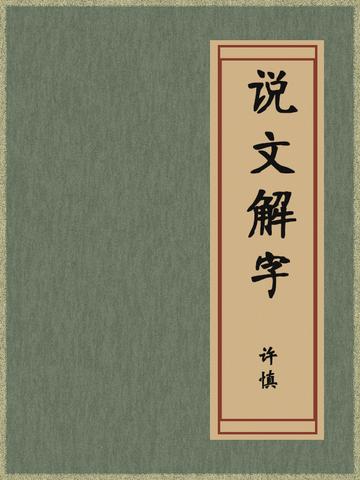
Philological works. It is the first masterpiece of philology in the history of our country that has clear parts and traces its origins. It also occupies a very important position in the history of world linguistics. There are 14 chapters in the main text and 1 chapter in the narrative. Later generations used the chapters to be heavy and divided each chapter into 30 volumes. This is the current version of the Xu edition. There are 9353 words collected, 1163 words repeated, and 133441 words explained. The prefix and heavy text are in ancient seal script, and the explanation is in official script. Set up 540 radicals, starting with and ending with Hai, and they are arranged according to the similarity of the glyphs; the characters included in each radical are arranged according to the relationship between the meanings of the characters. At the end of each part, total the number of articles and repeated articles; at the end of each article, total the number of radicals, articles, repeated articles, and explanations in the entire article, and mark them accordingly. To explain, first explain the meaning, then the form, and then the pronunciation. If the form, pronunciation and meaning are unclear, mark it with the word "que" for further examination.
This book pioneered the method of unifying radicals and characters, which is still used in dictionaries today. It has preserved more than 10,000 ancient characters, which can be used to study the history of Chinese characters and examine oracle bone inscriptions. It is the first example for the six books, and it is the first to interrelate shapes, sounds and meanings. It also retains a large number of ancient sounds, ancient sayings, and ancient materials, which are indispensable for exegesis, phonology, and archaeology. Disadvantages: There are errors in both explanation and meaning, sometimes with feudal overtones, and the arrangement system and radical establishment are not rigorous enough.
After the completion of "Shuowen", it was cited by famous scholars such as Zheng Xuan and Ying Shao. It was continuously studied in the past dynasties and reached its peak in the Qing Dynasty. There were dozens of experts and hundreds of special books. Duan Yucai, Guifu, Zhu Junsheng and Wang Jun were called the "Four Masters of Shuowen". Ding Fubao, a recent scholar, compiled more than 200 research works into "Shuowen Jiezi Jierin". With this volume, all the theories of various schools can be read.
In modern studies of "Shuowen", new progress has been made by mostly using oracle bones and bronze inscriptions to corroborate each other. The original version of Xu's book has been lost for a long time. The earliest version found today is a Tang Dynasty fragment, and the current version is the Erxu version. The Xiaoxu version is based on Daoguangjian Qi Minzao's engravings, and the Daxu version is based on Sun Xingyan's Pingjin Guan series of books. Sun Ke retained the old style of the Song version, but the features were unclear and the errors remained. During the reign of the Qing Dynasty, Chen Changzhi changed it into a one-seal and one-line version according to Sun Ke, and added proofreading, which made the whole book clear and clear.