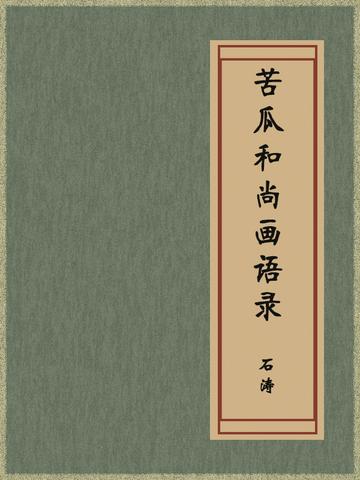
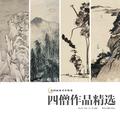
A. "Quotations from Shi Tao's Paintings", a treatise on Chinese painting. Yuan Ji was a calligrapher, painter, painting theorist, and monk. His common surname is Zhu and his given name is Ruoji. He is a native of Quanzhou, Guangxi, and a descendant of Zhu Shouqian, the king of Jingjiang in the Ming Dynasty. Due to family difficulties, he became a monk at the age of five. His Buddhist name was Yuanji, with the nickname Achang and Shitao. His nicknames were Dadizi, Chenren of Qingxiang, Yiren of Qingxiang, blind venerable, and old man Lingding in the later years. He called himself the bitter melon monk. He is good at painting flowers, fruits, orchids and bamboos, and also works on figures. He is especially good at landscapes and has a great reputation for painting. He was a calligrapher and was good at poetry and prose. Together with Hongyun, Kuncan and Zhu Da, he was known as the "Four Eminent Monks of the Early Qing Dynasty" and had a great influence on the later Yangzhou Painting School and modern painting style. He studied the philosophies of Jingshi, Taoism and Confucianism, studied the theory of painting in depth, and integrated his own creative practice experience. He wrote "Painting Quotations", a book with 18 chapters in one volume. The content can be roughly summarized as: (1) Observation objects and expression techniques, such as "Painting Chapter 1" and "Law Chapter 2"; (2) How to reflect the feelings obtained from nature, such as "Zunshou Chapter 4" and "Zi Ren Chapter 18"; (3) Subject matter processing and artistic conception, such as "Realm Chapter 10" and "Path Chapter 11"; (4) Use artistic means to express the depicted objects, such as "Chapter Five of Pen and Ink", "Chapter Six of Movement Wrist", "Chapter Seven of Qianzi", "Chapter Nine of Cunfa", "Chapter Fourteen of Four Seasons"; (5) Explain the origin of art and how to draw on the past to open up the present and create innovations, such as "Chapter Seventeen of Jianzi", "Chapter Three of Changes", etc. The reasoning is profound and organized from beginning to end. The discussion attaches great importance to the observation of nature, saying that landscapes should be "born out of mountains and rivers", "searching for all the strange peaks to make drafts", advocating "borrowing the past to open up the present", and denouncing the imitation of the past as "leftovers" of cannibalism, etc. Some chapters in the article have mysterious wording and are mixed with Lao Zhuang's thoughts and Zen language.