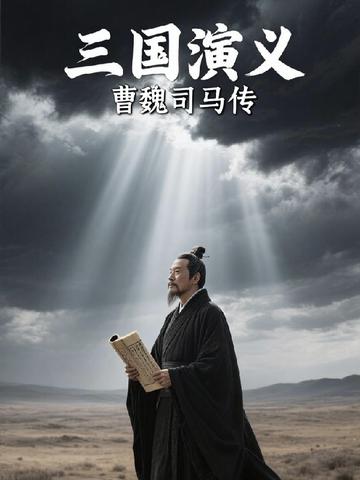
"The Romance of the Three Kingdoms: The Legend of Cao Wei and Sima": Machiavellian plots in troubled times and the forbearance of three generations
When the era of the heroic leader Cao Cao came to an end, the stage of power did not remain calm. This book uses the grand historical background as the canvas, focuses deeply on the core of power of the Cao Wei Dynasty, and takes the complex relationship between the three generations of emperors Cao Cao, Cao Pi, and Cao Rui and Sima Yi as the main line, and delicately outlines a magnificent epic of power.
It tells how Sima Yi went from being a suspected civil servant to relying on his extraordinary wisdom and forbearance to work step by step under the eyes of Cao Cao, and finally became Cao Pi's loyal minister, laying the groundwork for his future rise. With Cao Pi's ascension to the throne, the story enters an era of "deep palace intrigues and three-legged chaos". Sima Yi took advantage of Cao Pi's suspicion of his clan kin to cleverly suppress Cao Zhi and Cao Zhang. In the border frictions with Shu Han and Soochow, he showed outstanding military talent and gradually gained military power. Several duels with Wolong Zhuge Liang, especially the "Battle of Street Pavilion" and "Empty City Strategy", not only consolidated Sima Yi's supreme prestige in the army, but also cleared the last external obstacles for his path to power. The story reaches its climax and enters the final chapter of "The star falls in the Central Plains and Sima replaces the Wei Dynasty". After Zhuge Liang passed away, Sima Yi turned his attention to the Wei court. With his astonishing forbearance and "pretending to be ill" strategy, he paralyzed Wei Ming Emperor Cao Rui and powerful minister Cao Shuang, and finally launched the Gaopingling Revolution at a critical moment, taking control of Cao Wei's power in one fell swoop and ushering in the replacement of the Cao family by the Sima family.