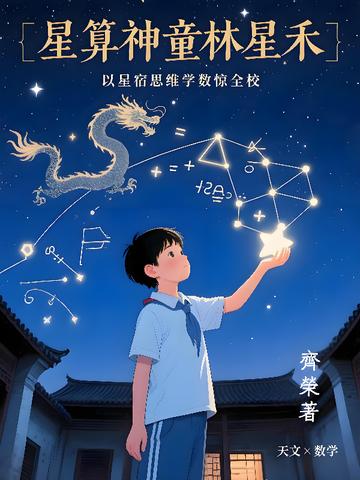
Lin Xinghe was widely regarded as the school's good-for-nothing at math.
Now in third grade, he still got half the addition and subtraction problems within 100 wrong. His math homework was always blank, his teacher shook his head whenever he came up, and his classmates teased him whenever they saw him: “Xinghe, staring at the stars again today? Can you eat them, or turn them into points?”
That all changed the day he dug out the old armillary sphere his grandfather had left behind
As its bronze rings turned, the distances between stars in the Purple Forbidden Enclosure became a place-value chart in his eyes. The arrangement of the Seven Mansions of the Azure Dragon made multiplication tables spring to mind, and even the notoriously difficult chicken-and-rabbit-in-a-cage problems in his textbook were hidden in the cycles of the Twenty-Eight Mansions.
Fragments of The Zhoubi Suanjing taught him to use a gnomon and shadows to work out geometry, while illustrations in The Nine Chapters on the Mathematical Art made fractions as simple as the waxing and waning moon. Six months later, he used “stellar distances” to solve a sixth-grade problem on the area of a circle and “gnomon shadow measurements” to solve a ratio word problem. His perfect score stunned the entire grade.
At an international competition, foreign experts sneered at his star-chart notes. “You call a child's doodles mathematics?”
Lin Xinghe pointed to the solution on his chart, which matched The Sunzi Mathematical Classic, and calmly replied, “These aren't doodles. They're the wisdom of our ancestors, carved into the stars.”
Later, his notes became a national treasure. The title page bore just one sentence: A good-for-nothing? Only someone who hasn't found their own patch of sky yet.