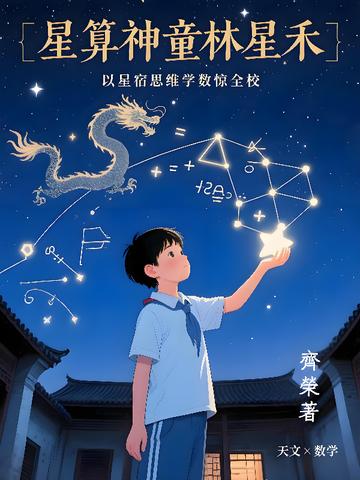
Lin Xinghe is recognized by the whole school as a math loser.
In the third grade, he can still get half of the addition and subtraction calculations within 100 wrong, and his math homework is always blank. The teacher shakes his head when he mentions him, and his classmates joke when they see him: "Xinghe, are you staring at the stars again today? Can you use it as food or as a math score?"
Until that day, he dug out the old armillary sphere left by his grandfather——
When the copper ring rotates, Zi Weiyuan's star distance becomes a digital table in his eyes. The arrangement of the Qinglong and the Seven Constellations makes the multiplication formula automatically emerge. Even the sad chicken and rabbit in the textbook are hidden in the rotation law of the Twenty-Eight Constellations.
The fragmentary pages of "Zhou Bi Suan Jing" taught him to calculate geometry by measuring shadows with a vertical pole, and the illustrations in "Nine Chapters of Arithmetic" made fractions as simple as the waxing and waning of the moon. Half a year later, when he used the "Distance of the Stars" to solve the area problem of a circle in the sixth grade, and used the "Guideophotometry" to calculate the comparative proportion problem, the full score in the test paper stunned the entire grade.
In the international arena, foreign experts looked at his star chart notes and sneered: "Does a child's graffiti deserve to be called mathematics?"
Lin Xinghe pointed to the solution on the picture that matched the "Sun Tzu Sutra" and said calmly: "This is not graffiti, it is the arithmetic wisdom carved in the starry sky by our ancestors."
Later, his notes became a national treasure, with only one sentence on the title page: Useless wood? It's just that I haven't found the starry sky that belongs to me.