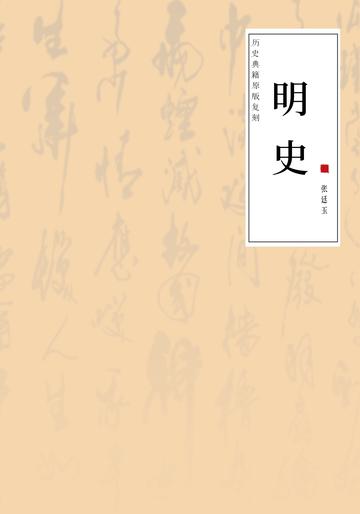
The History of Ming is the last of China's Twenty-Four Histories, a dynastic history written in annal-biography format. Compiled under the leadership of Zhang Tingyu during the Qing dynasty, it was officially printed in 1739, the fourth year of the Qianlong reign. The work comprises 332 volumes: 24 volumes of imperial annals, 75 treatises, 13 tables, and 220 biographies. It chronicles the 276 years of the Ming dynasty, from the beginning of the Hongwu reign in 1368 to the end of the Chongzhen reign in 1644.
Zhang Tingyu, courtesy name Hengchen and literary name Yanzhai, was from Tongcheng, Anhui. A high-ranking Qing official, he served as Minister of Rites and Grand Secretary of the Grand Council, among other posts. He oversaw several revisions of the History of Ming and was renowned for his meticulousness. He served as chief editor of the final draft.
The book provides a comprehensive account of the succession of Ming emperors, court politics, and the rise and decline of reforms. It also depicts a wealth of subjects, including civilization and ritual, the imperial examination system, economic institutions, and interactions among different ethnic groups. The treatises systematically document such institutions as the Ming system of garrison troops, the examination system, and fiscal arrangements. The biographies weave in the lives of numerous civil officials, military generals, and figures from frontier peoples, creating a rich and multifaceted historical panorama.
Although its hurried compilation led to errors and partiality, many of the official records on which it was based, such as the Veritable Records of the Ming and the Comprehensive Compendium of Statecraft, have since been lost. The History of Ming is therefore an indispensable foundational source for the study of Ming politics, institutions, and culture.
In short, the History of Ming is academically valuable for its rigorous structure, detailed sources, and disciplined style. It is both a grand political history and a monumental historical work depicting social life and institutional change, a major classic offered to later generations by historians of the Ming History Bureau, including Song Lian, Wang Yi, and Zhang Tingyu.