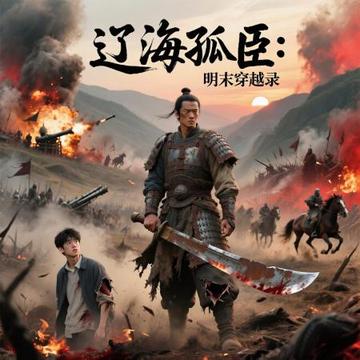
"Liao Hai Lonely Minister: A Time Travel Record in the Late Ming Dynasty"
——Knowing that he will die, he still fights until the last moment
When Li Ming, a history college student, woke up on the Saarhu battlefield, the rusty knife in his hand reflected the bloody sunset of 1619. He knew the script for the next 25 years: the Ming army would lose 45,000 elite troops in the Battle of Songjin, 800,000 people would be massacred in Yangzhou in ten days, and the Yongli Emperor would be hanged on the streets of Kunming - but at this moment, Jun Song's firearms camp was exploding, and the hoofs of Hou Jin's cavalry were shaking through the valley.
He went upstream with 21st century knowledge: he improved the three-eyed gun to have a 30% firing rate, used sand table deduction to convince Mao Wenlong, and predicted the cold wave and saved 300 people. But in the end, they couldn't stop him: when Yuan Chonghuan was tortured in the vegetable market, people competed for his meat, Hong Chengchou had his head shaved in Shenyang City and surrendered to the Qing Dynasty, and he lost his left arm in the Battle of Tashan.
Under the tree in Meishan, he watched the white silk hanging by Chongzhen swinging in the wind; on the streets of Kunming, he clutched the blood edict of Emperor Yongli; in the Taiwan Strait, he handed the manuscript of "The Divine Machine of Western Law" to Zheng Chenggong - this book did not change history, but it made the word "subjugation" more bloody: the artillery fire of defending Yangzhou with one arm, the cry of Li Dingguo's two famous kings, the hundreds of thousands of Liao people "I'd rather die than have my hair cut off" roared.
If you knew the outcome, would you still raise the rusty knife? Open this book and see the struggle of a modern man in the troubled times of the late Ming Dynasty: He could not save the Ming Dynasty, but it makes every reader want to ask - if it were me, could I do better?