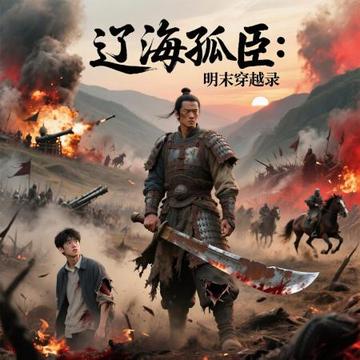
The Lone Minister of Liaohai: A Transmigrator’s Record of the Late Ming
He knew defeat was certain, yet he would fight to the very end
When Li Ming, a university history student, wakes on the battlefield of Sarhu, a rusty saber in his hand reflects the blood-red sunset of 1619. He knows the script for the next 25 years: the Ming army will lose 45,000 elite troops at the Battle of Songjin, 800,000 people will be massacred in Yangzhou over ten days, and the Yongli Emperor will be hanged on a street in Kunming. But right now, Du Song’s firearms battalion is exploding, and the hooves of the Later Jin cavalry are already thundering through the valley.
Armed with knowledge from the 21st century, he fights his way upstream against the current of history. He improves the firing rate of the three-barreled matchlock by 30 percent, persuades Mao Wenlong with sand-table exercises, and saves 300 people by predicting a cold snap. Yet in the end, he cannot prevent it: when Yuan Chonghuan is executed by dismemberment in the marketplace, onlookers fight over his flesh; Hong Chengchou shaves his head and surrenders to the Qing atop the walls of Shenyang; and Li Ming loses his left arm at the Battle of Tashan.
Beneath the crooked tree on Coal Hill, he watches the white silk with which Chongzhen hanged himself sway in the wind. On a street in Kunming, he clutches the Yongli Emperor’s bloodstained edict. In the Taiwan Strait, he hands Zheng Chenggong the manuscript of The Divine Machines of Western Methods. The book does not change history, but it lends some defiance to the words “the fall of a nation”: the cannon fire of Yangzhou, defended to the last by a one-armed man; Li Dingguo’s cries as he twice defeats a prince; and the roar of one hundred thousand people from Liaodong, “We would rather die than shave our heads.”
If you knew how it would end, would you still raise a rusty saber? Open this book and follow a modern man struggling through the chaos of the late Ming. He cannot save the dynasty, but he will leave every reader wondering: If it were me, could I have done better?