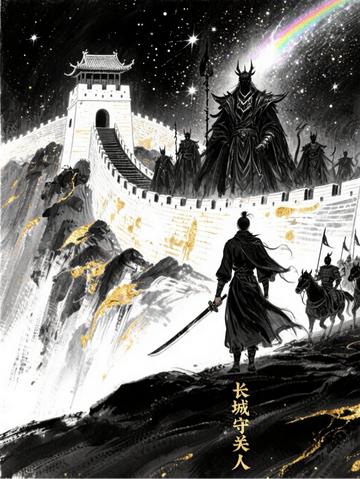
The story of brothers Yang Dahai and Yang Dashan, descendants of Qin general Yang Liao, guarding Huangya Pass.
The two brothers seem ordinary. They run a farmhouse and sell jujube juice respectively. They are nicknamed "Huangyaguan Shuangba", but they have the ancestral mission of guarding the Great Wall.
One night, the bricks and stones of the Great Wall moved abnormally, revealing the ancient seal "City in Danger". The brick pattern on Yang Dahai's chest burned, and the brothers were forced to use the magical power of "moving bricks" to calm the incident. Young Yang Shanyao discovered a genealogy in Lanshui Cave in Qishan Mountain and was shocked to see that he and Qin generals were juxtaposed. Yang Liao's phantom on the cave wall revealed that the Great Wall was condensed by the blood and tears of all people.
Later, Yang Shanyao, his brother Yang Shanzhi, Li Guanxing, a descendant of the Li family in Juyongguan, and Xuan Ying of the Xuannio bloodline, jointly faced the master of the "Black Order" and the remnants of the Meng family who coveted the Great Wall's territory. They experienced many dangers, restored the power of the gates, fought against evil spirits, and uncovered the secrets of the guardian families of the thirteen gates of the Great Wall, starting a guardian battle full of blood, fire, and inheritance that related to the survival of the Great Wall.
Reader comments
Nearly 100,000 words have passed, and the final result of Shanhaiguan is about to be announced. There may be some people who don't know Huangyaguan very well. I won't talk about it in the main text, but let's talk about it in the comments! The Huangyaguan Great Wall has a long and rich history. The following is a detailed introduction to its true history:
Founding and early development
• Begun in the Northern Qi Dynasty: The Huangyaguan Great Wall was built in the seventh year of Tianbao in the Northern Qi Dynasty (556). At that time, it was mainly to defend against the nomadic people in the north. It was built with earth and stone barriers based on the steep mountains. It was the early prototype of the Great Wall defense system.
• Utilization in the Sui and Tang Dynasties: The Sui Dynasty repaired it. During the Tang Dynasty, when Anlu Mountain rebelled against the Tang Dynasty, the elite Xiongwu Army was stationed here. The "Xiongwu City" mentioned in Du Fu's poem is near Huangyaguan.
Large-scale construction in the Ming Dynasty
• Improved strategic status: After Zhu Di, the founder of the Ming Dynasty, moved the capital to Beijing, Huangya Pass became the northern gateway to Jizhou City, and its military role became increasingly important. The emperors of the Ming Dynasty began to carry out large-scale additions and expansions based on the Great Wall of the Sui Dynasty.
• Qi Jiguang's renovation: When Qi Jiguang was the commander-in-chief of Jizhen, he redesigned and overhauled the Huangyaguan Great Wall. He not only carried out large-scale cladding with bricks to enhance the defensive capabilities of the city wall, but also built more than 1,200 hollow watchtowers. These watchtowers have multiple functions such as garrison, storage, and counterattack. In addition, Qi Jiguang also built the Guancheng of Huangyaguan according to the rules of Bagua, covering an area of 40,000 square meters, forming a unique Bagua city with intricate street layout, which is easy to defend but difficult to attack.
From the Qing Dynasty to the Republic of China
• Partial repairs in the Qing Dynasty: After the unification of the Qing Dynasty, although Emperor Kangxi stopped large-scale construction of the Great Wall, he still valued the military value of Huangya Pass and stationed at Huangya Pass eight times. During the more than 200 years of the Qing Dynasty, no large-scale construction of the Great Wall was carried out except for the restoration of the Tidiao Office and some important buildings located in the west of Huangyaguan City.
• Lack of protection during the Republic of China: During the Republic of China, the government did not pay enough attention to the protection of the Great Wall and did not repair the Huangyaguan Great Wall. As a result, the Great Wall buildings were eroded by wind and rain for a long time, and hollow watchtowers and other hollow watchtowers collapsed and were destroyed due to limited load-bearing.
Restoration and protection after the founding of New China
In 1984, the Tianjin Municipal Government decided to restore the Huangyaguan Great Wall and established the Jixian Great Wall Scenic Area Management Office the following year. From 1985 to 1987, the military and civilians worked together to repair the two open points of Huangyaguan and Taipingzhai. A total of 3,025 meters of wall, 20 towers, and 1 Baguaguan were restored. It was the longest part of the Great Wall restoration project in China.
Next is the interview with Guixu! The end or a new beginning?
Nearly 100,000 words have passed, and the final result of Shanhaiguan is about to be announced. There may be some people who don't know Huangyaguan very well. I won't talk about it in the main text, but let's talk about it in the comments! The Huangyaguan Great Wall has a long and rich history. The following is a detailed introduction to its true history: Founding and early development • Begun in the Northern Qi Dynasty: The Huangyaguan Great Wall was built in the seventh year of Tianbao in the Northern Qi Dynasty (556). At that time, it was mainly to defend against the nomadic people in the north. It was built with earth and stone barriers based on the steep mountains. It was the early prototype of the Great Wall defense system. • Utilization in the Sui and Tang Dynasties: The Sui Dynasty repaired it. During the Tang Dynasty, when Anlu Mountain rebelled against the Tang Dynasty, the elite Xiongwu Army was stationed here. The "Xiongwu City" mentioned in Du Fu's poem is near Huangyaguan. Large-scale construction in the Ming Dynasty • Improved strategic status: After Zhu Di, the founder of the Ming Dynasty, moved the capital to Beijing, Huangya Pass became the northern gateway to Jizhou City, and its military role became increasingly important. The emperors of the Ming Dynasty began to carry out large-scale additions and expansions based on the Great Wall of the Sui Dynasty. • Qi Jiguang's renovation: When Qi Jiguang was the commander-in-chief of Jizhen, he redesigned and overhauled the Huangyaguan Great Wall. He not only carried out large-scale cladding with bricks to enhance the defensive capabilities of the city wall, but also built more than 1,200 hollow watchtowers. These watchtowers have multiple functions such as garrison, storage, and counterattack. In addition, Qi Jiguang also built the Guancheng of Huangyaguan according to the rules of Bagua, covering an area of 40,000 square meters, forming a unique Bagua city with intricate street layout, which is easy to defend but difficult to attack. From the Qing Dynasty to the Republic of China • Partial repairs in the Qing Dynasty: After the unification of the Qing Dynasty, although Emperor Kangxi stopped large-scale construction of the Great Wall, he still valued the military value of Huangya Pass and stationed at Huangya Pass eight times. During the more than 200 years of the Qing Dynasty, no large-scale construction of the Great Wall was carried out except for the restoration of the Tidiao Office and some important buildings located in the west of Huangyaguan City. • Lack of protection during the Republic of China: During the Republic of China, the government did not pay enough attention to the protection of the Great Wall and did not repair the Huangyaguan Great Wall. As a result, the Great Wall buildings were eroded by wind and rain for a long time, and hollow watchtowers and other hollow watchtowers collapsed and were destroyed due to limited load-bearing. Restoration and protection after the founding of New China In 1984, the Tianjin Municipal Government decided to restore the Huangyaguan Great Wall and established the Jixian Great Wall Scenic Area Management Office the following year. From 1985 to 1987, the military and civilians worked together to repair the two open points of Huangyaguan and Taipingzhai. A total of 3,025 meters of wall, 20 towers, and 1 Baguaguan were restored. It was the longest part of the Great Wall restoration project in China. Next is the interview with Guixu! The end or a new beginning?