In the Western Regions after the An Lushan Rebellion, yellow sand buries white bones, and the trade routes lie silent beneath lonely beacons.
Bearing her family’s grievance, Shen Weiwan heads west through the Jade Gate with three carts of silk, only to run into the scorn of Chang’an’s aristocratic clans and the flashing blades of Tibetan cavalry. They say a merchant’s daughter has no right to set foot in the Western Regions, much less stand beside Xiao Jue, the God of War of Anxi.
Xiao Jue, the iron-blooded general who burned his family’s claim to inheritance, is fighting a hundred thousand Tibetan cavalry with a lone army. When he first meets her, she is bargaining with foreign merchants using counting rods. The ink in her ledger is mingled with dust, yet her words carry more weight than a military pledge.
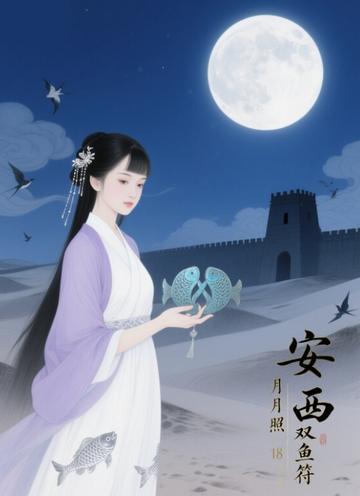
A paired fish tally seals their love, and commerce and the military become intertwined: she trades Shu brocade for Arab horses, while he protects Persian caravans with his cavalry. She unravels the aristocratic clans’ plots in her account books; he cuts down every rumor about her amid the beacon fires. Poisoned arrows from the remnants of the Liu family, an imperial decree from Chang’an arranging a marriage, a political marriage scheme by the Uyghur Khagan... Amid flashing blades, they have already ground all that idle talk about whether they are worthy into dust along the Silk Road.
But as the Dunhuang murals begin depicting their story and children of Han and foreign descent sing “The Song of Xiao and Wan,” an even greater storm is brewing. Does the secret letter hidden in a Kucha Buddhist grotto hold the truth behind the false charges against Shen Weiwan’s father, or a shocking conspiracy capable of overturning the Western Regions?
Camel bells shatter the moonlight, and dawn glints on their armor. They will string the trade routes like a bow and draw it with military blades, to play a long song across these ten thousand miles of Western Regions: “Han and foreign, sharing the same dust; in life and death, side by side.” But this time, can the winds of Chang’an still tear their tightly clasped hands apart?