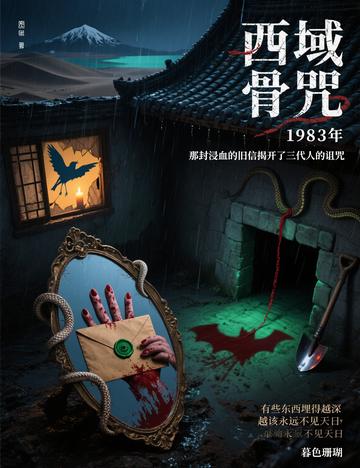
On a rainy night in Tianjin in 1983, veteran Xue Qiang found a fire-sealing letter among his third uncle's belongings, and the dark red powder mixed with the earthy smell of Lop Nur hit his face. The "river worker" key in the letter not only pried open the cellar of the old house, but also revealed a bloody mystery that spanned twenty years - the truth about the disappearance of the third uncle in Lop Nur in 1975, the severed finger left by the six-finger archaeological team in Changbai Mountain, and the ancient curse that the Buddha's bones would be sacrificed by human beings.
The bronze mirror reflects more than just human faces. The coordinates of Xinjiang Yadan and Changbai Lake are hidden on the front and back. When Xue Qiang stepped into Taklimakan with his brother Zhu Zhu who dug the Haihe River, Lin Lan who knew how to survive in the wild, and Su Rui, a medical girl, they discovered that the howl of the desert wolf was mixed with Morse code, and the giant snake totem behind the mural of the Thousand Buddha Cave echoed the blood poison birthmark on the back of his companions' neck.
From the golden Buddha in the caves of Kunlun Mountain to the gunshots on the cliffs along the Lancang River, the scarred faces of the Buddhist Bone Society are always like maggots attached to their bones. It wasn't until Shen Qing's daughter raised the bronze mirror in the Xisha diving bell and reflected the four words "Guotai Minan" on the reef that she saw the explosive that the third uncle used hemp rope as a fuse before he died - it turns out that the so-called Buddha bones have never been salvation.
After twenty years of tracking and searching for the bones in Sanhe, what they excavated was not an ancient tomb, but it was clearly the greediest desires and the strongest emotions in the human heart. When the last Buddha bone shone brightly in the deep sea, Xue Qiang finally understood: the deeper something is buried, the more likely it is that it will never see the light of day.