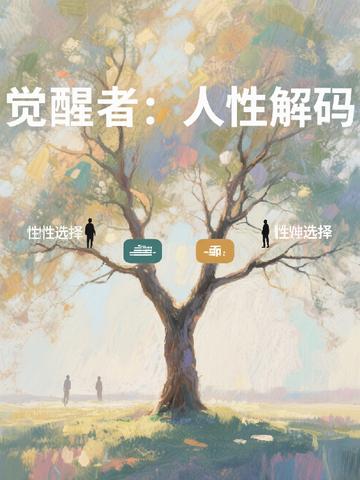
Lin Jue wore the shell of "success", but felt torn apart in the hypocritical group portraits at the annual meeting, touched the edges of the truth in the power game in the conference room, and was ultimately trapped in the quagmire of cognition.
Su Ming, a good friend from college, opened up his dilemma by questioning "Should human nature be deconstructed or reconstructed?" CEO Zhou Siyuan's power play reveals the complex logic of survival of the strong; psychoanalyst Xia Wei's professional prism reflects the abyss of his heart; low-level programmer Chen Mo's code philosophy reveals the simple algorithm that breaks down interpersonal relationships. Therefore, Lin Jue embarked on a "field investigation" of human nature: listening to the tears of strangers in the subway, facing the cognitive fault lines between generations in family quarrels, weighing power and responsibility in the data leakage storm, and catching a glimpse of the true nature of de-identification in anonymous social interactions.
This is not the awakening of superpowers, but a cognitive revolution - using empathy to break down prejudices and systematic thinking to break the framework. In 220 slices of human nature, he gradually understood: high-dimensional cognition is never the arrogance of overlooking all living beings, but still holding on to the coordinates after seeing the rules clearly; human nature is never a black-and-white judgment question, but a multi-faceted prism of thousands of colors that needs to be decoded rather than judged.
When hypocrisy and sincerity, survival and ideals were competing in front of his eyes, Lin Jue finally understood: Awakening is just a matter of recognizing the grayscale of human nature, and still having the courage to write a new algorithm for life - from "living" to "living fully", from "being defined" to "customizing".