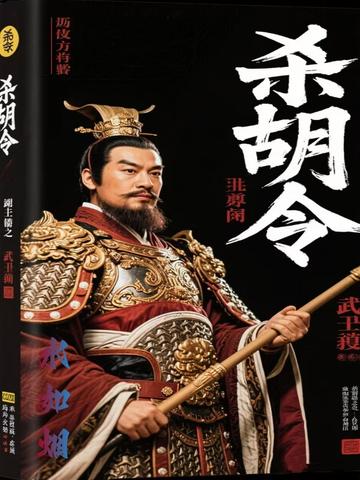
As the son of Ran Liang, a general of Later Zhao, Ran Min grew up under Jie rule, witnessing the tyranny of the Hu people and the suffering of the Han people. Seeds of resistance took root in his heart. At the age of six, after his father died in battle, Shi Hu adopted him as a grandson, and he grew up torn between conflicting loyalties.
With exceptional martial and military talent, Ran Min rose to prominence in Shi Hu's army, winning one battle after another while remaining devoted to the Han people. He secretly protected Han civilians, and his conflicts with Hu nobles, including Crown Prince Shi Sui and the powerful Zhang Bao, grew increasingly severe.
After Shi Hu's death, Later Zhao descended into turmoil. Ran Min gradually gained control of the military amid political infighting. Facing the suspicion of the new ruler, Shi Shi, and the exclusion of the Hu nobility, he began secretly planning a revolt.
In 350 CE, Ran Min issued the historically momentous “Order to Kill the Hu,” calling on the Han people to resist Hu oppression. The balance of power in Ye shifted overnight, and Ran Min founded the Ran Wei regime, launching a Han uprising.
Surrounded by Hu forces on all sides, Ran Min led his army from victory to victory, displaying astonishing military prowess. At the Battle of Mianshui, he defeated the Qiang forces under Yao Xiang, consolidating his fledgling regime.
Murong Jun of Former Yan joined forces with others to attack Ran Wei. Though Ran Min was invincible on the battlefield, the disparity in national strength and internal defections gradually drove him into dire straits. In 352 CE, during his final battle, he was captured after his horse stumbled. Facing Murong Jun's interrogation, he spoke with impassioned defiance. He ultimately died a heroic death, but his spirit became an enduring symbol of the Han people's resistance to foreign aggression.