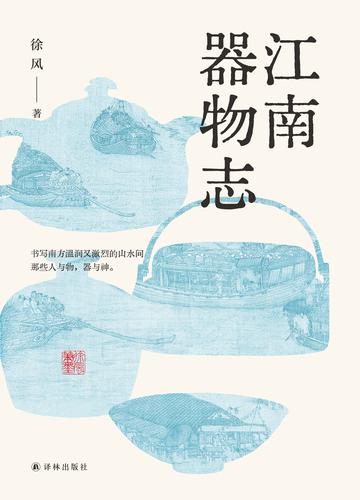
This is a "Jiangnan version of "Along the River During Qingming Festival" constructed with words. The long series of essays "Jiangnan Utensils" describes the origin, inheritance, and evolution of folk utensils from many aspects of social life such as imperial examinations, crops, festivals, customs, marriages, catering, courtyards, furniture, clothing, boats, and gifts. It also writes about the cultural characteristics and essence of civilization behind the utensils, and writes about the implementation and development of Chinese culture in the soil of Jiangnan. From keel waterwheels to rakes and hoes, from dishes to tripods and niches, the author, while reviewing the ancient utensils in Rice, Rice, Soup and Fish, unearthed the history, culture, anecdotes, and emotions in them, and imagined the behinds of the utensils. It tells the story of people and the spirit of Chinese culture in a representative ancient town on the west bank of Taihu Lake in the south of the Yangtze River for more than a hundred years.
The book uses methods such as field investigation, research on famous objects, combing through historical records, ancient books, and "intangible cultural heritage" retrieval, and uses literary deduction to closely follow the close and mysterious relationships between artifacts and people, and presents the code of traditional Jiangnan social life behind the artifacts. Writer Xu Feng breaks away from traditional prose narratives and interweaves historical research, non-fiction writing and lyrical writing. In the name of Jiangnan, he uses artifacts to talk about the world, salvage the essence of "intangible cultural heritage", and reproduce the lives and emotions of the working people in Jiangnan, as well as the majesty of the river of artifacts.
Material is memory, and each object is a world. Through the elegance, obsession, kindness, and compassion related to the objects, Xu Feng writes about the friendship of an era, the soul of a place, and the heartache and joy that are still difficult to let go. In the continuous image of the utensils, the work not only restores the traditional life in the south of the Yangtze River, but also enriches the lives of the current Chinese people, and ultimately points to the endless Chinese spirit and life aesthetics behind the utensils.
Reader comments
The collection of essays that Amway picked up when I was doing the questions reads like a Kunqu Opera tune, every detail is precise and elegant.
The collection of essays that Amway picked up when I was doing the questions reads like a Kunqu Opera tune, every detail is precise and elegant.