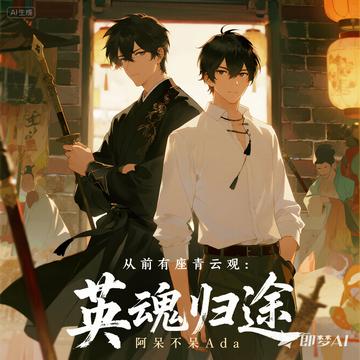
There Was Once a Qingyun Temple: The Fallen Heroes' Journey Home
从前有座青云观:英魂归途
- Status
- Ongoing
- Length
- 188k Words
- Genre
- Historical
- Subgenre
- War & Espionage
- Updated
- 1y ago
- Source
- Fanqie
Synopsis
67Chapters
75Reads · all time
More by this author
In booklists 5

New Writers, Come On In
It's so upsetting to keep seeing the stats barely change. The reader count doesn't go up at all, and there isn't a single comment. Hardly anyone reads the whole book, and by the last chapter, almost no one is still reading. New authors, let's support one another.
1.9kBooks5.9MViews1dUpdated
How Long Does It Take for a New Writer to Make It? I’ve Been Writing for 54 Days
54 days. I finished my first book on day 45: 320,000 words, writing for 8–12 hours a day. I’m now planning my second book, but nobody’s reading the first one anymore. Is it really that bad? Am I just someone with no talent? (sobbing)
1.8kBooks5MViews1dUpdated
New Authors With No Traffic, Come Swap Reviews and Keep Each Other Warm
I'd like books similar to "At the Summit of Beifeng".
1.5kBooks3.8MViews1dUpdated
No Romance, Ghost Hunting, Metaphysics, Remember: No Romance!!!
342Books15.7MViews1dUpdated
Looking for Exceptionally Well-Written Books, Preferably No-Romance Ensemble Casts
No romance pairings! None!!!
74Books52.4kViews2moUpdated
Reader comments 1
Translated by Google Translate
This is a two-male protagonist and group portrait novel with fictional history + supernatural fantasy, but what it wants to talk about is actually far more than "supernatural" and "fantasy"—— What I want to say is: "They are still on the road, how should we take them home." The story begins on the ninth day of the twelfth lunar month in 1937. The Taoist temple was burned and the incense was about to be extinguished. The three-year-old Taoist boy Xuanming guarded the last stick of incense and watched with his own eyes as his disciples were all loyal and died in a foreign land. He later went to the battlefield and died in a foreign country. But this "soul-returning journey" is not his alone. Decades later, another young man Lin Jianwei appeared. He is not a time traveler or a destined protagonist, but an abandoned orphan with "eyes in the sky". What he wants to do is to bring the souls of those heroes who sacrificed their lives but never returned home - to truly go home. 📜 The novel is fictional, but inspired by real history: For example, in 1938, Yuan Shaoyi, a high-ranking Taoist priest of the Longhu Mountain Zhengyi sect, left his last poem before he died for his country, "I would rather guard the dust of the country than watch the thieves invade hundreds of miles of territory"; Another example is that in the Maoshan Anti-Japanese War Memorial Hall, there is still a list of Taoist priests who went to the battlefield and died heroically; Too many Taoist temples have been destroyed, and too many heroes have no name. They are not legends or myths - they are real people who have existed. 🔮 So although this book is "fantasy", I want to write about a kind of "belief": They have protected us, and we should take them home. Xuan Ming is the epitome of those unknown Taoist priests. I wrote this book not for pleasure or passion, but because I hope to use this story to tell a story about a "way home" that has been ignored but cannot be forgotten. I hope you are willing to click in and take a look, even if it is just for the incense stick, the last poem, or the immortal Qingyun Temple. ——I would like to write this book to commemorate those unknown heroes who sacrificed their lives for the country. There is no way back for them and we can walk it for them. Because at Qingyang Palace, I saw children from the Northern Taoist Temple going to buy books for their master. Bang Bang Buying. Is it strange that there are no books in the Taoist temple? Then I immediately realized that during the Japanese invasion of China, Taoist priests went down to the mountains to help the world... Almost all the temples were empty, and some temples had only one youngest disciple left behind, or the inheritance was completely cut off... Most of the Taoist classics were burned by the Japanese invaders or plundered to Tokyo and refused to be returned... In addition, after seeing the historical stories of the Maoshan Anti-Japanese Memorial Hall and other things I knew, I couldn't help but write this book.