In the year 1931 of the Chen calendar, the Onmyoji and monks secretly sent by the Kingdom of Dawn mixed into the people of the Dragon Kingdom, disguised themselves as business travelers and monks, and sneaked into the mountains and rivers.
They measured the pulse and spirit, quietly cutting off the dragon's luck; they also sacrificed blood to tens of thousands of Onmyoji and the common people, in order to overdraw their country's national destiny in exchange for a chance to win the war.
They vainly attempted to cut off the souls of the country, and their troops pointed directly at the hinterland of China.
In the Chenli year of 1937, Xiaori sent out all-out troops, and war raged across the north and south. The seven disciples of Baiyunguan, the thirteen Taoist priests of Qianyuan, and the Taoists of the Eight Immortals Palace all went down the mountain to resist the enemy, but no one survived.
Only the three-year-old Xuan Ming in Qingyun Temple was left behind by the Taoist brothers to hold on to his glory.
Six years later, Xuanming took in Chen Huaian, a teacher whose family was ruined. Since then, Qingyun has gained a silent mountain guardian. As the war continued, Chen Huaian began to adopt war orphans. Even when the temple was rebuilt after the war, he often took abandoned babies back to the mountains to raise them.
He didn't believe in gods, but he guarded Qingyun Temple for half his life.
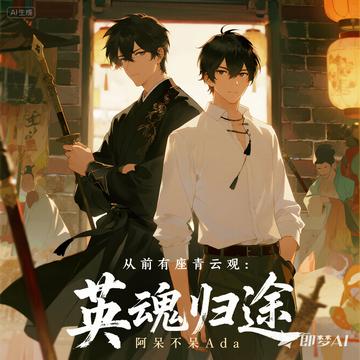
Among these orphans, there is one who has been able to see souls and energy since he was a child, and is extremely talented. His name is Lin Jianwei——
He didn't know that his ordinary surname "Lin" was the real surname of Xuanming, the heroic soul who died early.
Eighteen years later, Lin Jianwei used the power of "Sky Eye" to act together with Shen Yanhui, the highest-level passer of the National Institute of Special Studies, and embarked on a journey to return to the soul.
They went from the southern border of the Dragon Kingdom to the broken wall of Chenbei, from the post-war village to the Xiaori Spiritual Prison,
Traveling through all the battlefields, soul prisons and forbidden areas that have never been commemorated, just to accomplish one thing:
——Guide the way for those loyal souls who failed to return, and light the stick of incense in Qingyun Temple.
Even if the lights are about to go out, there are still people holding up the lights and moving forward;
Even if thousands of souls are nameless, someone still needs to pave the way home for them.
Reader comments
This is a two-male protagonist and group portrait novel with fictional history + supernatural fantasy, but what it wants to talk about is actually far more than "supernatural" and "fantasy"——
What I want to say is: "They are still on the road, how should we take them home."
The story begins on the ninth day of the twelfth lunar month in 1937. The Taoist temple was burned and the incense was about to be extinguished. The three-year-old Taoist boy Xuanming guarded the last stick of incense and watched with his own eyes as his disciples were all loyal and died in a foreign land. He later went to the battlefield and died in a foreign country.
But this "soul-returning journey" is not his alone.
Decades later, another young man Lin Jianwei appeared. He is not a time traveler or a destined protagonist, but an abandoned orphan with "eyes in the sky".
What he wants to do is to bring the souls of those heroes who sacrificed their lives but never returned home - truly go home.
📜 The novel is fictional, but inspired by real history:
For example, in 1938, Yuan Shaoyi, a high-ranking Taoist priest of the Longhu Mountain Zhengyi sect, left his last poem before he died for his country, "I would rather guard the dust of the country than watch the thieves invade hundreds of miles of territory";
Another example is that in the Maoshan Anti-Japanese War Memorial Hall, there is still a list of Taoist priests who went to the battlefield and died heroically;
Too many Taoist temples have been destroyed, and too many heroes have no name. They are not legends or myths - they are real people who have existed.
🔮 So although this book is "fantasy", I want to write about a kind of "belief":
They have protected us, and we should take them home.
Xuan Ming is the epitome of those unknown Taoist priests.
I wrote this book not for pleasure or passion, but because I hope to use this story to tell a story about a "return" that has been ignored but cannot be forgotten.
I hope you are willing to click in and take a look, even if it is just for the incense stick, the last poem, or the immortal Qingyun Temple.
——I would like to write this book to commemorate those unknown heroes who sacrificed their lives for the country.
There is no way back for them and we can walk it for them.
Because at Qingyang Palace, I saw children from the Northern Taoist Temple going to buy books for their master. Kuang Bang Buy. Isn't it strange that there are no books in the Taoist temple? Then I immediately realized that during the Japanese invasion of China, Taoist priests went down to the mountains to help the world... Almost all the temples were empty, and some temples had only one youngest disciple left behind, or the inheritance was completely cut off... Most of the Taoist classics were burned by the Japanese invaders or plundered to Tokyo and refused to be returned... In addition, after seeing the historical stories of the Maoshan Anti-Japanese Memorial Hall and other things I knew, I couldn't help but write this book.
This is a two-male protagonist and group portrait novel with fictional history + supernatural fantasy, but what it wants to talk about is actually far more than "supernatural" and "fantasy"—— What I want to say is: "They are still on the road, how should we take them home." The story begins on the ninth day of the twelfth lunar month in 1937. The Taoist temple was burned and the incense was about to be extinguished. The three-year-old Taoist boy Xuanming guarded the last stick of incense and watched with his own eyes as his disciples were all loyal and died in a foreign land. He later went to the battlefield and died in a foreign country. But this "soul-returning journey" is not his alone. Decades later, another young man Lin Jianwei appeared. He is not a time traveler or a destined protagonist, but an abandoned orphan with "eyes in the sky". What he wants to do is to bring the souls of those heroes who sacrificed their lives but never returned home - truly go home. 📜 The novel is fictional, but inspired by real history: For example, in 1938, Yuan Shaoyi, a high-ranking Taoist priest of the Longhu Mountain Zhengyi sect, left his last poem before he died for his country, "I would rather guard the dust of the country than watch the thieves invade hundreds of miles of territory"; Another example is that in the Maoshan Anti-Japanese War Memorial Hall, there is still a list of Taoist priests who went to the battlefield and died heroically; Too many Taoist temples have been destroyed, and too many heroes have no name. They are not legends or myths - they are real people who have existed. 🔮 So although this book is "fantasy", I want to write about a kind of "belief": They have protected us, and we should take them home. Xuan Ming is the epitome of those unknown Taoist priests. I wrote this book not for pleasure or passion, but because I hope to use this story to tell a story about a "return" that has been ignored but cannot be forgotten. I hope you are willing to click in and take a look, even if it is just for the incense stick, the last poem, or the immortal Qingyun Temple. ——I would like to write this book to commemorate those unknown heroes who sacrificed their lives for the country. There is no way back for them and we can walk it for them. Because at Qingyang Palace, I saw children from the Northern Taoist Temple going to buy books for their master. Kuang Bang Buy. Isn't it strange that there are no books in the Taoist temple? Then I immediately realized that during the Japanese invasion of China, Taoist priests went down to the mountains to help the world... Almost all the temples were empty, and some temples had only one youngest disciple left behind, or the inheritance was completely cut off... Most of the Taoist classics were burned by the Japanese invaders or plundered to Tokyo and refused to be returned... In addition, after seeing the historical stories of the Maoshan Anti-Japanese Memorial Hall and other things I knew, I couldn't help but write this book.