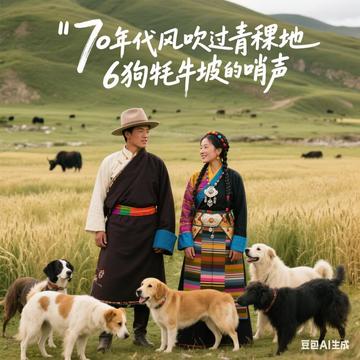
In 1968 on the Western Sichuan Plateau, Lisen, a Tibetan boy from the Highland Barley Village, met Wang Luoke, a city girl who went to the countryside with his parents on Yakniupo. He is as silent as a mountain, but can command six stray dogs with his whistle; she is as agile as a stream, breaking into his world with a picture book and candy wrappers from the city. Lao Huang protected her from the yak, while Hui Hui took the herbs in his mouth for him. His white eyebrows reflected the two people cuddling together in front of the commune movie - the footprints of six dogs marked the original bond between the mountains and the city.
When they parted in 1975, she left behind a red rope bracelet, and he knitted Lao Huang's hair into the knot; in the abandoned church in 1976, the thorns of the wild roses he picked for her were all wiped clean; under the oil lamp when the college entrance examination was resumed, he gnawed on the textbook she sent, and Xiao Hei lay beside him to warm his feet. From the straw rope sandals on the highland barley slope, to the boiled eggs outside the county examination room; from the Tibetan greetings at the earthen wall wedding, to the support on the anti-guai charity road, the red rope bracelets were worn and renewed, the wild roses bloomed and withered, and a sea of flowers grew on the graves of six dogs.
Forty years later, the white-haired Li Sen will still whistle for dogs on the yak slope. In Luo Ke's painting book, on the last page of the painting book, there is a line next to "Six Dogs Surrounding Two Children": "The wind remembers all the stories, and the stars are blinking dogs." This was the 1970s. Love, as clumsy as a rope woven from dog hair, as tough as a flower in a crack of stone, has blown over time into a long poem - about protection, about growth, about how two souls, like wild roses, entwine their roots into eternity in the barren years.