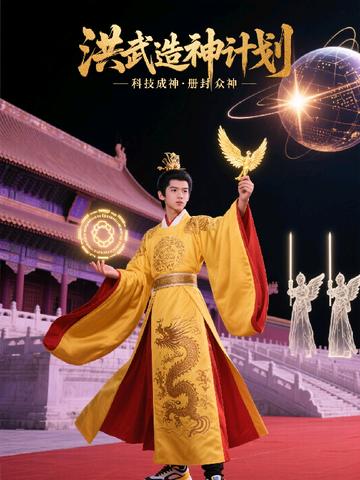
Zhu Yuntong, a modern social beast, was struck by lightning while watching "Super Seminary" and his soul was pierced through the Ming Dynasty, and he became Zhu Yunxi, the eldest grandson of the emperor. What's even more outrageous is that the Super Seminary System has become his golden finger. The Kamigawa Gene, the Angel Sequence, the Fiery Sun Heritage... These powers that only exist in anime have suddenly become the trump cards that he can hold in his hand.
Facing the decisive and aggressive grandfather Zhu Yuanzhang, the gentle and generous father Zhu Biao, and the eyeing uncle Zhu Di, Zhu Yunxi touched the system panel and had a problem: directly say that he can create gods? I'm afraid that I won't be regarded as a lunatic who deceives the public with his lies.
So, he used the genetic blueprint to develop the "Art of Observation of Objects". First, he used an electromagnetic igniter to frighten Lao Zhu, and then secretly inserted angel genes into the Imperial Army as a "Dharma Protector". He also secretly planned to tailor-make the Sun Emperor suit for his grandfather - after all, the emperor must have the ability to control the stars!
He battled wits with scheming civil servants in court, gave his "supernatural power" to confused generals in private, and occasionally had to deal with uncles who wanted to seize the throne. Family ties intertwined with power, technology and history collided. Zhu Yunxi stepped on the accelerator of genetic technology and created a "technological heaven" in the Hongwu Dynasty: he canonized the gods, formed an angel army, and planted the dragon flag of the Ming Dynasty across the sea of stars.
Who said that time travel can only lead to the throne? He, Zhu Yunxi, wants to make the entire Ming Dynasty ascend to godhood!
Reader comments
It's inconsistent. The prince is still alive in the first three chapters, but he dies in the second chapter. The contradiction is also far-fetched.
It's inconsistent. The prince is still alive in the first three chapters, but he dies in the second chapter. The contradiction is also far-fetched.