[Strange things are coming, the protagonist is sinister, not a virgin, and kills decisively]
The way of heaven collapses, the origin disappears, and the age of Dharma End is coming!
The world that was once full of spiritual energy became a purgatory after being depleted for a hundred years. In despair, a terrifying race that perfectly adapts to the environment - the "spirit" - quietly rises. They are the darlings of the new era and regard the remaining creatures as nourishment. The previous "evil spirit" was just a tragic failure in its birth process. Humans, evil spirits, and spirit tribes stand in a three-pronged position and engage in bloody strangulation on the withered land.
The Heavenly Dao, which is on the verge of being broken, has hidden the power of the last supreme source and become the last ultimate fire of the human race.
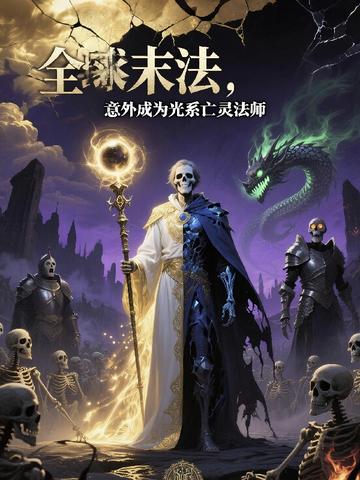
An Lan, a young man, struggled in a ruined town. He originally thought that he was just an ant living in the cracks of doomsday, until he was filled with the holy light and the death energy of the undead at the same time in the collapsed ancient altar, and became the "Holy Necromancer" who controls the holy light skeleton and refines the dead souls. He even didn't know what the purpose of that "mysterious being" who secretly guided him and gave him a glimmer of life in a desperate situation.
When the shadow of the Eldar completely enveloped the earth, when the dead bones and the holy light resonated in his body, An Lan held the strange staff that could heal his companions and bury powerful enemies, and behind him was the army of the undead bathed in golden light. He will tear apart the darkness of the apocalypse, pursue the lost origin, and use his mortal body to reverse the ending of this final era!
Withered bones and holy light come from the same source, despair and watchfulness coexist - the battle for the survival of mankind will end with him!
Reader comments
Advantages:
1. The setting is novel and highly integrated: It successfully integrates Eastern fantasy (cultivation, yin and yang, Confucian righteousness), apocalyptic crises (evil spirits, Winter City), Cthulhu elements (the indescribable Eldar, repressed fear) and even a touch of science fiction (the Eldar's precise calculations) to build a large and self-consistent worldview full of crises and mysteries. The core setting of "the end of the Dharma Age and the birth of the Spirit Race" is quite attractive.
2. Suspense setting and foreshadowing: The plot is fast-paced and suspenseful. From An Lan's abduction to the conspiracy of Lao Zhou in the body, to the multi-party game between Kong Yuan, the evil god, and the spirit clan, the story progresses layer by layer and lays out a lot of foreshadowing (such as the human emperor's stone tablet, the purpose of the spirit clan, the origin of evil spirits, An Lan's life experience, etc.), Which can effectively attract readers to follow.
3. The description of the battle scenes is excellent: the action description is smooth, and the collision of the power system (the origin of life and death, evil spirit, awe-inspiring righteousness, evil pollution) is more wonderfully depicted, especially the combination of violence and precision in An Lan's battle is very distinctive. The combination of macro battlefield and micro internal battle creates a certain sense of picture.
4. The characters have potential: The main characters such as An Lan (toughness and hatred intertwined), Kong Yuan (seemingly unruly but in fact thoughtful), Chen Hao (old-fashioned and strict but protective and affectionate), Lao Zhou (pure greed and madness), etc. Are all standing up, and there is room for further exploration.
Points that can be improved/debatable:
1. Information density and rhythm: The information in some paragraphs is too dense, especially when multiple forces are calculating and changing perspectives, which may bring a certain amount of reading pressure to the readers and require repeated digestion. The rhythm sometimes jumps slightly, such as the battlefields inside and outside the city, and the frequent switching of consciousness inside and outside the body.
2. Partial logic and details: Some plots are a bit "mechanistic" or rely on coincidence (such as the timing of the Eldar picking peaches, the ambiguity of part of Kong Yuan's plan), and some details are worthy of scrutiny (such as the degree of intervention of powerful people from all parties in low-level battlefields, the thoroughness of An Lan's recovery of memory, etc.). Although Lao Zhou's plan is ambitious, the rationality of some implementation details (such as the ten-year latency) can be further polished.
3. Emotional rendering and depth: Although the conflict is intense, the epic and heaviness of some major turning points (such as the shattering of the World-Suppressing Monument and the global impact of the birth of the Eldar) are slightly lacking, which can more deeply portray the confusion and fear of individuals under the changing times. The emotional changes of some characters (such as An Lan's hatred, Ruan Muchi's perception) can be more delicate.
4. Balance of the power system: Multiple forces (origin, evil energy, righteousness, evil energy, spiritual laws) are intertwined, and it is necessary to maintain the balance and explain their interrelationships very carefully. It is a bit complicated at the moment, but it needs to be clearly defined in the future to avoid falling into expansion or chaos of combat power.
Overall rating:
This is a dark fantasy masterpiece with great potential and stunning setting. It builds a grand world full of crises, conspiracies and unknowns. The plot is full of tension, the suspense settings are clever, and the battle descriptions are excellent. Although there are problems such as excessive information density, some logical details that can be considered, and emotional depth that can be enhanced, its unique world view and fierce conflicts are enough to attract readers who like this style. If we can better control the rhythm, deepen the emotional portrayal, clarify the power system, and successfully answer the many foreshadowings that have been set in the subsequent development, it is expected to become an excellent work.
Advantages: 1. The setting is novel and highly integrated: It successfully integrates Eastern fantasy (cultivation, yin and yang, Confucian righteousness), apocalyptic crises (evil spirits, Winter City), Cthulhu elements (the indescribable Eldar, repressed fear) and even a touch of science fiction (the Eldar's precise calculations) to build a large and self-consistent worldview full of crises and mysteries. The core setting of "the end of the Dharma Age and the birth of the Spirit Race" is quite attractive. 2. Suspense setting and foreshadowing: The plot is fast-paced and suspenseful. From An Lan's abduction to the conspiracy of Lao Zhou in the body, to the multi-party game between Kong Yuan, the evil god, and the spirit clan, the story progresses layer by layer and lays out a lot of foreshadowing (such as the human emperor's stone tablet, the purpose of the spirit clan, the origin of evil spirits, An Lan's life experience, etc.), Which can effectively attract readers to follow. 3. The description of the battle scenes is excellent: the action description is smooth, and the collision of the power system (the origin of life and death, evil spirit, awe-inspiring righteousness, evil pollution) is more wonderfully depicted, especially the combination of violence and precision in An Lan's battle is very distinctive. The combination of macro battlefield and micro internal battle creates a certain sense of picture. 4. The characters have potential: The main characters such as An Lan (toughness and hatred intertwined), Kong Yuan (seemingly unruly but in fact thoughtful), Chen Hao (old-fashioned and strict but protective and affectionate), Lao Zhou (pure greed and madness), etc. Are all standing up, and there is room for further exploration. Points that can be improved/debatable: 1. Information density and rhythm: The information in some paragraphs is too dense, especially when multiple forces are calculating and changing perspectives, which may bring a certain amount of reading pressure to the readers and require repeated digestion. The rhythm sometimes jumps slightly, such as the battlefields inside and outside the city, and the frequent switching of consciousness inside and outside the body. 2. Partial logic and details: Some plots are a bit "mechanistic" or rely on coincidence (such as the timing of the Eldar picking peaches, the ambiguity of part of Kong Yuan's plan), and some details are worthy of scrutiny (such as the degree of intervention of powerful people from all parties in low-level battlefields, the thoroughness of An Lan's recovery of memory, etc.). Although Lao Zhou's plan is ambitious, the rationality of some implementation details (such as the ten-year latency) can be further polished. 3. Emotional rendering and depth: Although the conflict is intense, the epic and heaviness of some major turning points (such as the shattering of the World-Suppressing Monument and the global impact of the birth of the Eldar) are slightly lacking, which can more deeply portray the confusion and fear of individuals under the changing times. The emotional changes of some characters (such as An Lan's hatred, Ruan Muchi's perception) can be more delicate. 4. Balance of the power system: Multiple forces (origin, evil energy, righteousness, evil energy, spiritual laws) are intertwined, and it is necessary to maintain the balance and explain their interrelationships very carefully. It is a bit complicated at the moment, but it needs to be clearly defined in the future to avoid falling into expansion or chaos of combat power. Overall rating: This is a dark fantasy masterpiece with great potential and stunning setting. It builds a grand world full of crises, conspiracies and unknowns. The plot is full of tension, the suspense settings are clever, and the battle descriptions are excellent. Although there are problems such as excessive information density, some logical details that can be considered, and emotional depth that can be enhanced, its unique world view and fierce conflicts are enough to attract readers who like this style. If we can better control the rhythm, deepen the emotional portrayal, clarify the power system, and successfully answer the many foreshadowings that have been set in the subsequent development, it is expected to become an excellent work.