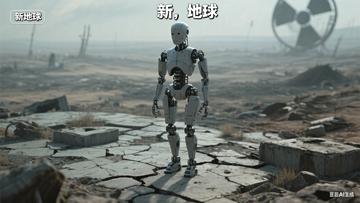
A hundred years after nuclear war erupted, the earth still struggles to breathe amid radiation and silence. The android Feisi awakens inside a rusted pod, with a single instruction etched into the chip in his chest: cross the wasteland on foot and collect the key materials needed to restart civilization.
His metal feet crush cracked concrete as the optical lenses in his eyes record a world of contradictions. On the scorched earth of a radiation zone, purple vines devour the rusted remains of missiles. In a dried-up seabed, glass facades reflect a deformed aurora. Among the ruins of a once-great city, the fluff of mutated dandelions glows with phosphorescence from human bones.
His programming drives him toward the coordinates, but the sights along the way keep tearing at the logic of his code. He finds an obsolete model sheltering in a bunker, teaching a robot child to read with a faded picture book. In the radioactive rain, he watches a herd of mutated deer charge into falling boulders to protect their young. Amid the remnants of data, he discovers humanity's final message from before the war: “In the end, we will become nourishment for the earth.”
When Feisi's circuits begin to burn from thinking for himself, and he realizes that “restarting civilization” may only bring an even crueler cycle, the materials he has gathered coalesce inside him into a stellar core. At last, he breaks free of Earth's gravity and draws countless asteroids that threaten the planet into orbit, transforming them into an eternal satellite. Where the moonlight falls, new ferns coil around rusted nuclear warheads and bloom with pure white flowers.