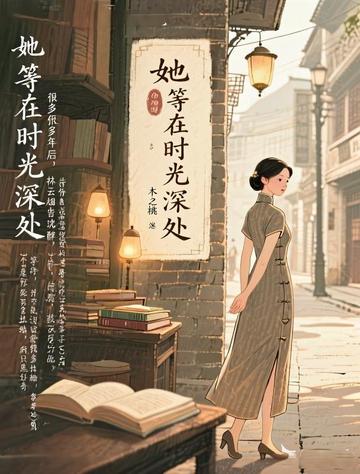
Republican-era setting, inspired by real people and adapted from history, with a focus on resistance against Japan (not a power fantasy)
When she was four, she knelt outside Shen Zui’s window and heard him say, “Girls should read more books, too.”
When she was fourteen, she married into the Shen family. On their wedding night, all she got was, “Go to sleep. I still have books to read.”
For the rest of her life, she kept waiting.
Waiting for him to turn and look at her, to realize she was more than “a gift from Mother,” to say, “I’m back.”
He used his pen to awaken a slumbering nation, writing stirring articles for a turbulent age under the name Zhenying. She spent her life keeping the pharmacy on Liuhua Alley open, becoming a mountain of strength amid war, plague, and upheaval.
He died in the south and never came home.
She wore his pocket watch on her wrist, listening to it tick for fifty-eight years. She compiled his writings into a book, protecting the last spark amid the ashes.
As she lay dying, a new bud appeared on the flowering crabapple outside her window, though it was winter.
She smiled and said, “I’ve waited long enough.”
Waiting was never about the outcome.
Waiting was the outcome.
She waited in the depths of time, and time carved her into a poem.
What he never knew was that she turned the pharmacy into an underground contact point, treating countless resistance fighters in occupied Beiping; that she snatched his writings from the Red Guards’ bonfire and hid them in the ashes of the stove; that she inscribed his name on the title page of his collected works, so future generations would remember that once there was a man who wielded his pen like a blade.
He never knew, either, that she had never stopped waiting for him.
She wasn’t waiting for him to come back. She was waiting for him to see that she had become every word he had ever written.