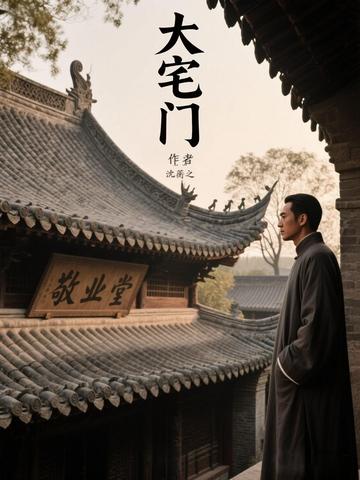
Under the eaves of gray bricks and gray tiles, the plaque of "Jingye Hall" has been hanging in the wind and rain for three hundred years.
The Huangmeiyu period during the Guangxu period always carried an inexorable dampness. Sixteen-year-old Cha Longjian stepped on wooden clogs and walked through the corridor. The fragments of the genealogy hidden in his arms were soaked in moisture, and the corners were green and black.
He didn't know that this old paper secretly handed to him by his tribe would become the shackles and confidence of his life. From the wisteria trellis of the old house in Haining, to the salty smell of Qingdao Yancang, to the red-painted gate of Jinan Mansion, the footprints of the Cha family are imprinted on the map of the late Qing Dynasty and the early Republic of China, like a string of ink marks of different shades.
The lingering fear of the Literary Prison, the swords of the guild, and the weapons of the foreigners all hit this heavy house door, making the door knocker ring.
It was only when Zha Longjian grasped the inkstone with "Jingye Hall" engraved on it at the Yellow River ferry that he understood his father's final words.
"To protect one's roots is not to protect a piece of land, but to protect one's breath."
This tone is hidden in the tampered last words, wrapped in the slight smell of the heart of the stove, and engraved on the bent and unbroken spine of each generation.
Inside the door is the struggle between account books and poems, and outside the door is the rut of the times.
And the mottled door of the mansion, after opening and closing countless times, became a postmark of history in the years, covering all the secrets about persistence...
Reader comments
The article is delicate, the writing style is compact, and the characters' psychology is vividly portrayed.
The article is delicate, the writing style is compact, and the characters' psychology is vividly portrayed.