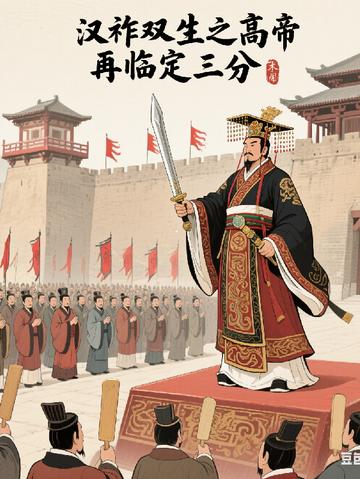
Liu Bang, the great ancestor of the Han Dynasty, returned twice to the end of the Han Dynasty and possessed the puppet Emperor Xian Liu Xie.
The first time travel coincided with Dong Zhuo's political chaos. He and the heroes of Chu and Han fought for hegemony, trying to bring order to the chaos with thunderous means, but they underestimated the sharpness of the fangs in troubled times - trusting relatives, eager to reduce military power, and finally suffered from the weapons of Li Jue and Guo Si, watching the Han Dynasty and the ancestral temple fall into dust.
Seven years later, he was reborn in Xuchang Palace. Cao Cao had "held the emperor hostage to order the princes." The previous blood lesson was unforgettable. This time, Liu Bang restrained his imperial edge, hid his heroic spirit of "the strong wind blows and the clouds fly", and was willing to be a bird in a cage and a prisoner. He bowed to Cao Cao during the court meeting, followed Han rituals carefully during sacrifices, but secretly acted like a hidden dragon in the abyss: weaving a dense network with the help of the Xiaohuang Gate, cultivating dead soldiers with the help of Yu Linlang, amassing wealth and silk with the royal workshop, and reviewing the gains and losses with the "Qianlong Policy".
During the Guandu beacon fire, he secretly deployed chess pieces to consume the two strong men; before the stormy waves of Chibi, he took advantage of the opportunity to divide Sun Cao; on the land of Guanlong, he replicated the farming of the early Han Dynasty and reorganized the military system of the north and south. From Xuchang to Chang'an, from puppet to leader of the alliance, he used the power of Emperor Gao to make up for Emperor Xian's predicament, and used the blood and tears of his two journeys to forcibly carve out a path for the rejuvenation of the Han Dynasty in the cracks between the three parts of the world.
When the bells of Weiyang Palace rang again, Liu Bang stood in front of the steps, looking at the unified territory of the Han Dynasty, and finally understood that reviving the Han Dynasty was never about reversing history, but about understanding the people's hearts - just like the three chapters he had made at that time, just like the restoration of Guangwu, the Han Dynasty continued to advance, and virtue was not in danger.