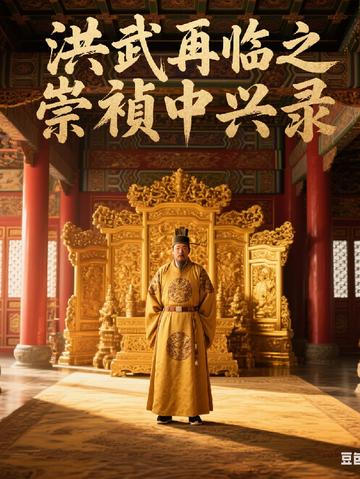
"The Return of Hongwu: Chongzhen Zhongxing Lu" tells the story of the salvation epic in which the soul of Ming Taizu Zhu Yuanzhang traveled twice and attached itself to the body of Chongzhen Emperor Zhu Youjian in the late Ming Dynasty.
For the first time, Hongwu was unable to defeat the evils of the late Ming Dynasty: the eager execution of Wei Zhongxian led to the disintegration of the eunuch party and the loss of control of the civil service group; forced tax collection to force the people to revolt; suspicion of military generals destroying the Great Wall, and finally Meishan hanged himself in the 17th year of Chongzhen, witnessing the destruction of mountains and rivers, and endless regrets.
The rebirth goes back to the end of the seventh year of the Apocalypse, and Zhu Yuanzhang taught the story with blood and tears and took charge of the endgame again. Faced with the confrontation between the Donglin Party and the Eunuch Party, the early civil uprising in Shaanxi, and the border troubles that the Later Jin Dynasty was eyeing, he changed his mind - temporarily staying in Wei Zhongxian to control civil servants, collect military pay, and use imperial power to control the eunuchs. Rather than eradicate it; suppress and divide the Donglin Party to avoid empty talk that would harm the country; military affairs trusted Sun Chengzong, Yuan Chonghuan and other generals to delegate power and make decisions on the fly; economically, they rectified water transportation and opened sea taxation to relieve people's difficulties.
From the dangers of the Jisi Incident to the combined suppression and suppression of rebellions in the northwest, from the power play between eunuchs and civil servants to the strategic counterattack against Hou Jin, Zhu Yuanzhang used the iron blood and wisdom of Emperor Hongwu to turn the tide at the turning point of history in the late Ming Dynasty, reconstruct the order of the Ming Dynasty, and finally become the "Chongzhen ZTE". The book is deeply rooted in the official system, military, and folklore details of the Ming Dynasty, showing how a founding emperor used the experience of his second life to rewrite the fate of the dynasty's collapse and compose a salvation chapter that is both historical and political.