Stats
5.8Score
Synopsis
No synopsis yet.
We haven’t got an English blurb for this one. It appears once the source description has been translated.
Reader comments
In booklists 2
An Essay on Cultivating Immortality with More Than 10 Million Words
I want to read a book similar to "The Art of the Emperor of Chaos".
9.4MViews373Books2dUpdated
Why Do Newcomers Lose Traffic the More They Write?
Doomsday, alien world, system, and sign-in are all available.
2.1MViews292Books14hUpdated
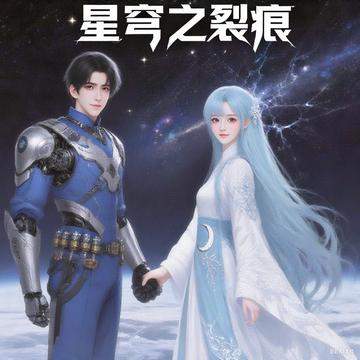
The plot is very rich. Ling Xing, Yue Li, and Yan Lie are constantly moving forward to repair the cracks, which allowed me to understand a strange and bizarre world. According to reports, this book is very long, suitable for listening to books, so you don't have to look for books everywhere. Thank you to the author for [flying a kiss][flying a kiss][flying a kiss][flying a kiss][flying a kiss][flying a kiss] The plot is getting richer and richer
"Cracks in the Starry Sky" constructs a grand and mysterious picture of the universe. The legend of the Stardust Key is full of temptation and conspiracy. The protagonist Ling Xing explores the truth amidst dangers. The plot has ups and downs, from abandoned space stations to mysterious ruins, and is full of suspense. It combines elements of science fiction, adventure and suspense. It is fascinating and makes people can't wait to embark on this interstellar exploration journey. I've finished chasing the rest of it, and I'm still left with endless aftertaste! [Praise]
This book is based on the legend of the universe, and Ling Xing is involved in a crisis due to the Stardust Key. From the abandoned space station to the silicon-based ruins, the journey is full of suspense: Kai's weirdness, mysterious organization, family secrets, interstellar adventures and human puzzles intertwined, exciting and fascinating, I really want to follow up! I read part of it earlier, and today I caught up with the latest chapter in one go. Recommended reading!
In the entire universe, besides us carbon-based organisms, what else is there? If it were a pure carbon-based organism, would there be no upper limit to IQ? Reading them one by one shows the author's great and high-level narrative ability. The chase is over! ! So beautiful!
"The Crack in the Starry Sky" unfolds as an interstellar mystery, with endless suspense. Ling Xing's life experience is a mystery, the key triggers a crisis, "eclipse" creatures are intertwined with mysterious organizations, and the dark truth of the universe is fascinating. An interstellar adventure not to be missed by science fiction fans!
I really like Ling Xing. He is just but decisive in killing. He represents invincibility but is low-key! Stardust Key🔑This design is also good, the story design is clever and reasonable, I have always liked this style!
This book is great! The description of the interstellar warships is like exploding in front of your eyes, and the protagonist's growth line from a marginal soldier to overturning the situation is very exciting. The author blends the grandeur of the universe and the struggle of human nature just right, and the foreshadowing is deep. Every chapter is intriguing and intriguing. Five stars!
"Cracks" are both geographical barriers and civilization test questions: some civilizations use anti-matter weapons to explode cracks and plunder resources, and some use gravity anchors to repair them. Human beings are caught in the middle and choose survival or morality. Antimatter annihilation efficiency and gravitational anchoring calibration are all scientifically supported, making the game of civilization not empty and the depth that a hard core should have.
If you love the depth of deconstructing civilization in The Three-Body Problem, this book will fascinate you. It deduce the transition from carbon-based to silicon-based civilization and the threshold from planet to interstellar civilization, with scientific support. It also objectively writes about the survival logic of different civilizations, and the moral dilemma of human beings "sacrificing the few", which directly touches people's hearts.
The starry vault has the romance of nebulae and twin star planets, but the cracks hide devouring crises. When human beings encounter "crystal civilization", the author uses crystals to metabolize by star radiation to explain the reasons why they compete for high-energy areas. He uses scientific logic to talk about the game of civilization, which is full of the romance and cruelty of the universe.
The "star dome" in the book is very three-dimensional: there are nebulae, black holes, and cracks in the folds of space and time. The protagonist explores cracks in "space-time fragments", watching a supernova in one second, and falling into an ancient nebula in the next. This is a deduction based on the instability of time and space, and also deduces the difference in the flow rate of time. The romantic image hides scientific logic, which is grand and rigorous.
This book is hard-core and not preachy: the quantum entanglement communicator resists crack signal interference, and the anti-distortion protective clothing copes with the space-time field. Even the monitoring data charts have radiation curves and distortion indexes, giving it a sense of scientific investigation. When the data pointed to silicon-based civilization, we realized that the details were all the keys to decryption.
This hard-core book is super "down to earth": there is no levitation black technology, the cross-rift communication station needs to solve the time and space misalignment signal delay, engineers adjust the frequency, use a gravitational lens to focus, and the details are full of scientific sense. When the communication station receives an alien signal, encodes the parameters of the hidden star, and sets the service plot, the crack becomes the soul of the book.
Reading it is like participating in a cosmic scientific investigation: the opening chapter deciphers interstellar signals, from frequency characteristics, coding rules to civilizational intentions, with precise reasoning. The truth is that the two civilizations collided due to the laws of cosmic resources. They discussed not only technology, but also the position of human beings in the universe. The pattern was shocking.
The details of the crack are ultra-realistic: the internal space-time flow rate is 1.7 Times that of the external one, the spacecraft shell is blue-shifted when passing through, and the crew's biological clock is disrupted, which is derived from the theory of relativity. The protagonist stayed up for 48 hours to calibrate the parameters, making people understand that courage and scientific rigor are the foundation before the starry sky.
The rift is a gap in the universe and a crisis for human survival: the human group "Stardome Repairer" is a hard-core designer of dark matter capturers and gravitational lens arrays. Someone was trying to protect the trap and was torn apart by the gravitational field. Only then did he realize that behind the vastness of the starry sky was the weight of individuals using their lives to protect civilization, and the hard core concealing tenderness.
This book is "Dissecting the Star Dome with Science": the crack is not a gap in space, but a weak zone in space and time where dark matter collides with normal matter. Even the gravitational lensing effect and radiation fluctuations are written in detail. When the protagonist gives up the signal from his home star to prevent the rift, the vastness and crisis of the starry sky hide the insignificance and tenacity of human beings, which is both hard-core and heart-wrenching.
The science and technology in the book has buds of reality: the brain-computer interface is used to solve the problem of consciousness dormancy in interstellar navigation, and the principle of neural adaptation is written; the space elevator takes into account material strength and earth's gravity. This kind of fantasy that respects science makes the future believable and easy for readers to immerse themselves in, as if they are not far from the world in the book.
Opening "Cracks in the Starry Sky" is like being pulled into the folds of the universe by gravitational waves. The "star dome" and "cracks" turn into interstellar channels torn by dark energy and faults with abnormal curvature of space and time, which are rooted in astrophysics and hidden in the plot. The protagonist drives a quantum entanglement engine spaceship to repair space-time chaos. The engine calculation is rigorous, the suspense is intriguing, and the core is not obscure.
It was super enjoyable to read: The author asked hard-core questions, such as "AI takes the initiative in scientific research, will humans be eliminated?" There are no simple answers, and the plot leads to thinking. The settings of quantum physics and celestial mechanics are not obscure, and it can also increase your knowledge. It is a masterpiece worth reading again and again.
Not bad, keep up the good work It's beautiful, but I don't have time to watch it. It's awesome.
Mysterious interstellar story!
I would like to ask the author if the Daxing wheat cake is delicious? Give me one!
The male protagonist is both unfortunate and lucky. When he meets his love, his uncle raises him and wishes him success!
The plot of this book is very nice It's wonderful. Ling Xing, Yue Li, and Yan Lie are my favorite. Yan Lie is my favorite. Come on.
I recently discovered a super nice book, as exciting as a science fiction movie
It's so beautiful. The author will update it quickly and take me to continue to travel the universe. I've finished reading it again.
This article is like a colorful picture. The author uses delicate brushwork to outline every detail, which is vivid and vivid, making readers feel as if they are actually there.
This book gives people a new perspective, which is really good
"A Crack in the Star Vault" is full of science fiction charm. It uses Stardust keys to connect adventures. Crisis and mystery are intertwined. The fate of the characters affects people's hearts. It is worth reading for science fiction fans. Good books are worth reading carefully!