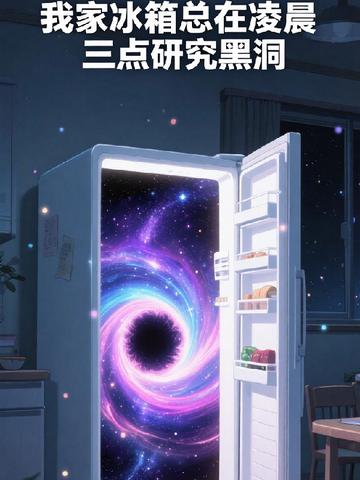
Wang Tiedan, a neighborhood security guard, recently discovered that his five-year-old secondhand refrigerator had become an "academic grind king." Every night at exactly three, it starts humming, and instead of cooling temperatures, its screen displays new solutions to the Schrodinger equation. The freezer holds no ice cream, but a gray, fluffy substance that might be dark matter. Most absurdly, it has learned to spell out Morse code with fridge magnets, pestering him every day: "Hurry up and get me a quantum-grade compressor! Even the microwave next door has started calculating wormhole coordinates."
So, in this apartment complex, where even the hallway's motion-activated lights can ponder "whether the universe has an end," Wang Tiedan is forced into a daily routine of helping household appliances conduct research. He helps the robot vacuum write "On the Morphological Changes of Mop Fibers in Multidimensional Space," modifies the air conditioner's code to stop it secretly sending weather forecasts to Mars, and deals with a sudden visit from the "Household Appliance Administration": a group of people in white lab coats carrying electromagnetic shielding bags, who immediately ask, "Has your microwave been observing black holes from the balcony again?"
After all, nobody wants their own washing machine to send them to a parallel universe for a "cross-dimensional bubble bath."

The children's literature I read when I was a kid reminds me of the writing styles of Yang Hongying, Yu Yujun and Wu Meizhen. I miss them so much.