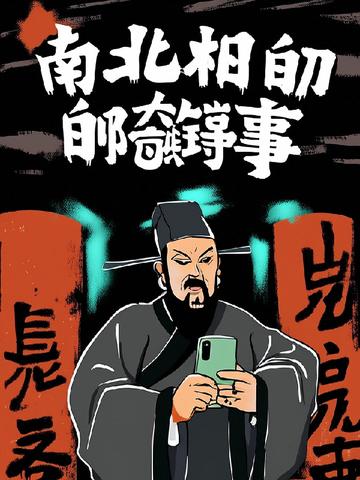
With a sharp and witty style, I’ll reveal to you, dear readers, the most absurd and chaotic era in Chinese history: fifty-three emperors took turns on the throne over the course of 170 years, a concentration of tyrants and inept rulers unmatched throughout history. Liu Yu, the “Pig King” of Liu Song, was locked in a pigsty by his nephew and left to eat from the trough. Xiao Baojuan, the Marquis of Donghun of Southern Qi, had gold carved into lotus flowers for his beloved consort Pan Yuer, so that every step she took would leave a fragrant blossom. Gao Yang of Northern Qi drank himself into a stupor, ran naked through the streets, killed a consort to make a bone pipa, then played and sang to himself. And Yuwen Yun of Northern Zhou ascended the throne the day after his father died, laughing as he slapped the coffin and cried, “He should have died sooner!” He seized his stepmother and installed five empresses to share control of the inner palace.
While Emperor Wu of Liang, Xiao Yan, entered the clergy four times and drained the treasury to buy his way back out, Emperor Xiaowen of Northern Wei, Yuan Hong, used a “southern campaign” as a pretext to forcibly move the capital to Luoyang. At court, the Xianbei aristocrats tearfully ripped off their nomadic clothes. Amid this farce of cultural collision between the Han and Hu peoples, the three daughters of Dugu Xin married into three successive dynasties, making him “history’s greatest father-in-law.” Meanwhile, Chen Shubao, the last ruler of his dynasty, hid in a dry well with his favorite consort as Sui troops stormed the city, singing “Flowers in the Rear Courtyard of the Jade Tree.”
Through a modern lens, this book unpacks an epic of fantastical history, where morality collapsed and heroes emerged. Amid the absurd tales of the “mad dynasty” of Northern Qi, where the Gao clan destroyed its own family, and the “Buddhist CEO” Xiao Yan starving to death in Taicheng, it probes the truth of human nature under the madness of power and bears witness to the magnificent dawn of the Sui and Tang golden age, born from the blood and tears of peoples coming together.