Ultraman+Kamen Rider+Super Sentai+Pretty Cure
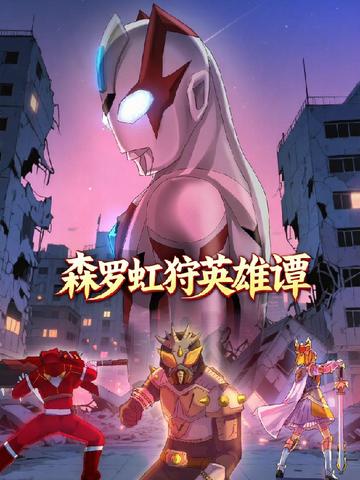
When the pink sky tears apart reality, the existence of monsters is no longer a fantasy on the screen, but a nightmare hanging above everyone's head? Or is it the real reality?
What is the connection between the successive "mysterious disappearances" and the emergence of unknown life forms?
Monsters fell from the sky, and masked hunters hidden in the crowd began to hunt! How to deal with another monster that appears?
The Precures are like stars, their light pierces the darkness, corrects the distorted monsters and returns them to their original stories!
Some people become aliens in order to protect the ordinary, while some people lose themselves in madness.
And they will eventually understand: the so-called heroes are just the most stubborn "human beings" in despair.
(This article is an original fanfic, mainly because I want to fulfill a dream I had when I was a child. To have a story of my own. I don't want to spoil too much about the content in the introduction. I will be very happy if you are interested. I will definitely complete this work...)
Reader comments
Let's talk about the conclusion first. "Senra Hongshou Heroes" is an outstanding work that perfectly combines the popular charm of tokusatsu themes with the in-depth pursuit of pure literature.
It successfully achieves an amazingly high degree of unity in literature, philosophical speculation and emotional expression among a variety of superhero series with different styles. (It's not you who touches me)
The greatest achievement of this work is that it allows the hero to return to his "human" nature, allows extraordinary combat to serve the thinking of the human condition, and makes behind the light of every transformation a real and tangible personality.
The most ordinary scenes are given philosophical weight without being remotely didactic. This writing method of "everyday special shots" proves that the foundation of supernatural themes lies precisely in the profound insight into ordinary life.
The control of the emotional rhythm is also very clever: from Tuan's innocence, Koichi's sin, Xuanjin's wavering, to Hayato's loss - every emotion is accurately placed at the right place in the narrative rhythm, without delay or haste, forming a "wave-like" emotional progression.
The response of the social system also has a sense of crisis. Sato's police line, Kunizaki's bureaucratic line, and the release of the "Citizen Response Manual" - demonstrate the social system's adaptation process to extraordinary crises, giving the world view a more realistic political thickness. It's been a long time since I've seen such a responsible central agency make me cry.
In terms of character creation, everyone is an ordinary person, and there is no such thing as a brainless hero who just opens his mouth and keeps talking to help others. The overall effect is that no monster time is invaded, very much like the Gurlitt series.
Rhythm control is also very distinctive.
Relaxation and relaxation: alternating between combat and daily life, balancing tension and relaxation.
Multi-line interweaving: Five main lines converge at critical moments, creating a superimposed effect.
The art of blank space: leaving the reader's imagination without explanation, so that readers can look forward to what will happen in the next chapter in each chapter.
The author's novel does not stay at the shallow narrative of "good triumphs over evil", but explores in depth: What does it mean to be a hero?
Its greatest achievement: returning so-called heroes to humanity. Let the hero become tangible and tactile again as he catches dolls, rides on the merry-go-round, explains fairy tales, and worries about what to eat for breakfast. It also makes the hero's powerlessness to save ordinary lives, the incomprehensible loneliness, and the weight of sin so real and painful.
What is created is not a "heroic universe", but actually a "human universe". In this universe, behind every transformed light is a real and tangible existence.
Come on, author, and look forward to the development of subsequent chapters.
Let's talk about the conclusion first. "Senra Hongshou Heroes" is an outstanding work that perfectly combines the popular charm of tokusatsu themes with the in-depth pursuit of pure literature. It successfully achieves an amazingly high degree of unity in literature, philosophical speculation and emotional expression among a variety of superhero series with different styles. (It's not you who touches me) The greatest achievement of this work is that it allows the hero to return to his "human" nature, allows extraordinary combat to serve the thinking of the human condition, and makes behind the light of every transformation a real and tangible personality. The most ordinary scenes are given philosophical weight without being remotely didactic. This writing method of "everyday special shots" proves that the foundation of supernatural themes lies precisely in the profound insight into ordinary life. The control of the emotional rhythm is also very clever: from Tuan's innocence, Koichi's sin, Xuanjin's wavering, to Hayato's loss - every emotion is accurately placed at the right place in the narrative rhythm, without delay or haste, forming a "wave-like" emotional progression. The response of the social system also has a sense of crisis. Sato's police line, Kunizaki's bureaucratic line, and the release of the "Citizen Response Manual" - demonstrate the social system's adaptation process to extraordinary crises, giving the world view a more realistic political thickness. It's been a long time since I've seen such a responsible central agency make me cry. In terms of character creation, everyone is an ordinary person, and there is no such thing as a brainless hero who just opens his mouth and keeps talking to help others. The overall effect is that no monster time is invaded, very much like the Gurlitt series. Rhythm control is also very distinctive. Relaxation and relaxation: alternating between combat and daily life, balancing tension and relaxation. Multi-line interweaving: Five main lines converge at critical moments, creating a superimposed effect. The art of blank space: leaving the reader's imagination without explanation, so that readers can look forward to what will happen in the next chapter in each chapter. The author's novel does not stay at the shallow narrative of "good triumphs over evil", but explores in depth: What does it mean to be a hero? Its greatest achievement: returning so-called heroes to humanity. Let the hero become tangible and tactile again as he catches dolls, rides on the merry-go-round, explains fairy tales, and worries about what to eat for breakfast. It also makes the hero's powerlessness to save ordinary lives, the incomprehensible loneliness, and the weight of sin so real and painful. What is created is not a "heroic universe", but actually a "human universe". In this universe, behind every transformed light is a real and tangible existence. Come on, author, and look forward to the development of subsequent chapters.