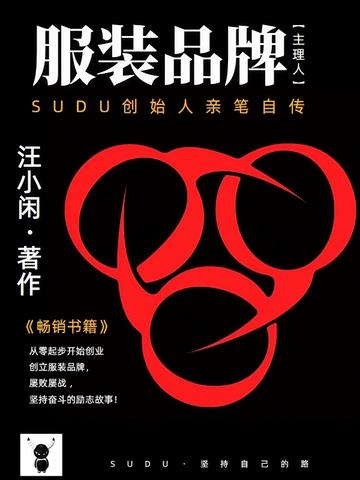
This book is the true business growth history of entrepreneur Wang Xiaoxian, recording his complete journey from setting up a street stall in 2003 to building the well-known brand SUDU.
In 2003, Wang Xiaoxian, who was studying at university in Hangzhou, set up a street stall selling clothes at Qingchun Road Night Market to earn tuition fees, and developed a sense of the most primitive business model. The experience of working in a bank after graduation gave him a deep understanding of credit value and the consumer market. Unwilling to rest in peace, he resolutely resigned, keenly seized the business opportunity of clothing inventory surplus, and made his first pot of gold in Sijiqing Wholesale Market.
With the rise of e-commerce, he transformed into online wholesale and was once named one of Alibaba's "Top Ten Experts and Celebrities". When the rise of micro-business was met with widespread skepticism, he took a unique approach to create the SUDU brand and built a private domain moat with the innovative model of "not suppressing goods, empowering agents". When the epidemic hit in 2020, the traditional business collapsed. He decisively led a core team of 12 people to fully transform into live streaming e-commerce. After experiencing many tests, he finally built SUDU into a benchmark account for quality clothing on the Douyin platform, achieving a counterattack from near death to rebirth.
During his twenty years of entrepreneurship, he has always adhered to the core concept of "serious attitude" - never fool around with products, never deceive users, and never let down partners. This is not only a story about the ups and downs of the clothing business, but also a reflection on integrity, resilience and the nature of business. It profoundly reveals: above all games of models, traffic, and capital, the ultimate barrier to business is the human heart. This is a "business experience" about persistence and evolution written by a grassroots practical entrepreneur over twenty years.
Reader comments
If you only regard this book as a guide on "how to make a lot of money by selling clothes", then you would be underestimating it. Wang Xiaoxian's story is essentially a Chinese businessman's journey of "mind cultivation". From bank elites to market stall owners, the psychological struggle caused by this identity gap is written in an extremely real way. You can see how he gradually implemented the "financial model" in the book into the "inventory turnover" in the warehouse, how he smashed the "management process" of large enterprises and turned it into a ruthless means to deal with the local snake "Scar Liu". This process is the "breaking" for him to lose his scholarly spirit, and it is also the "establishment" for him to absorb the wisdom of the market. The characters around him - the ruthless and righteous Yunfei, the shrewd and delicate Meifen, the upright and persistent Xiaoru... Are like a miniature river and lake, forcing him to balance interests and morality, to figure out human nature, and to understand what "kindness does not control soldiers, justice does not manage finances". The deepest insight from this book is that it reveals a certain essence of doing business in China: all business problems are ultimately human problems. It's not difficult to get things done, but it's art to get people done. Wang Xiaoxian is able to succeed not only because of his brilliant mind, but also because he can "defeat" powerful generals like Yun Fei, "coax" generals like Mei Fen, and "control" opponents like Fatty Zhang. In the process of dealing with people, he constantly revised his values and understood when to be reasonable, when to show his fangs, and when to be patient. This is the deep value of this book beyond "Shuangwen" - it allows you to see not the luck of a genius, but how an ordinary smart person stumbles to complete self-education and reshape his value in the university of society. After understanding Wang Xiaoxian's choices and struggles, you may also understand the inner monologues of countless trendsetters under the wave of China's private economy in the past two decades. All in all, this is an entrepreneurial record with flesh, bones and soul. It's exciting because of the plot, winning because of the truth, and valuable because of the thinking. Whether you want to start a business, are starting a business, or simply want to see the real operating logic of the world, this book will make you like eating melon seeds, unable to stop, and leave you with a mouth full of fragrance and endless aftertaste.
There are many books on entrepreneurship on the market, but most of them are like molecular cuisine carefully plated by the kitchen of a five-star hotel. They are good-looking, but they are too far away from the stoves of ordinary people. Wang Xiaoxian's autobiography is different! It's like the pot of "Jianghu Mix Sichuan" that's full of ingredients and stir-fried quickly on the streets of Hangzhou late at night. It's full of steam, filled with fireworks, and one bite is hot and satisfying. It's full of solid survival wisdom and a hot taste of life.
The most exciting thing about this book is that it is not pretentious and is terrifyingly real. Wang Xiaoxian is not the chosen one with a golden finger and a few small goals at every turn. He is a smart man who jumped out of the banking system and plunged into the "jianghu" of Sijiqing Clothing Market. He relied on his brains, courage, and thick skin, and a group of equally grassroots brothers and sisters (Yunfei the ruthless, Nancy the God of Wealth, Lin Xi the brainy, Xiaoru the barbarian, and Bobo the reckless) to fight his way out of poverty. You see him engaging in "imaginative marketing", making first pots of gold by rebranding off-price goods, outwitting the local snake Jin Da Ya, toughing up Fatty Zhang, tearing clothes off in Ice City and fighting with wool merchants... Every move and every move reveals the quick wit and fierceness that burst out after being forced into a corner by reality. It makes people slap their thighs: "Holy shit! You can still do this?!"
There are bright "brand ideals" on the table, and there are also "grayscale operations" that are forced on the table; there are business calculations, but also the warmth and warmth of human feelings; there is brotherly loyalty, and there is also the love between children. It tells you that dreams are expensive and you have to live to pay for them. In this book, Wang Xiaoxian vividly interprets the lofty sentiments and entanglements of "gathering of friends in all corners of the country" in a more market-oriented, lively, and "green all year round" way. Reading it, you feel like you are squatting at the noisy fire exit of the market, smoking a cigarette, listening to this "Brother Wang" talk to you from the bottom of your heart about the game under the wine table and the swords and swords in the warehouse. This is not a cold case in business school. This is a living record of a living person rolling in the mud and dancing on the tip of a knife.
If you only regard this book as a guide on "how to make a lot of money by selling clothes", then you would be underestimating it. Wang Xiaoxian's story is essentially a Chinese businessman's journey of "mind cultivation". From bank elites to market stall owners, the psychological struggle caused by this identity gap is written in an extremely real way. You can see how he gradually implemented the "financial model" in the book into the "inventory turnover" in the warehouse, how he smashed the "management process" of large enterprises and turned it into a ruthless means to deal with the local snake "Scar Liu". This process is the "breaking" for him to lose his scholarly spirit, and it is also the "establishment" for him to absorb the wisdom of the market. The characters around him - the ruthless and righteous Yunfei, the shrewd and delicate Meifen, the upright and persistent Xiaoru... Are like a miniature river and lake, forcing him to balance interests and morality, to figure out human nature, and to understand what "kindness does not control soldiers, justice does not manage finances". The deepest insight from this book is that it reveals a certain essence of doing business in China: all business problems are ultimately human problems. It's not difficult to get things done, but it's art to get people done. Wang Xiaoxian is able to succeed not only because of his brilliant mind, but also because he can "defeat" powerful generals like Yun Fei, "coax" generals like Mei Fen, and "control" opponents like Fatty Zhang. In the process of dealing with people, he constantly revised his values and understood when to be reasonable, when to show his fangs, and when to be patient. This is the deep value of this book beyond "Shuangwen" - it allows you to see not the luck of a genius, but how an ordinary smart person stumbles to complete self-education and reshape his value in the university of society. After understanding Wang Xiaoxian's choices and struggles, you may also understand the inner monologues of countless trendsetters under the wave of China's private economy in the past two decades. All in all, this is an entrepreneurial record with flesh, bones and soul. It's exciting because of the plot, winning because of the truth, and valuable because of the thinking. Whether you want to start a business, are starting a business, or simply want to see the real operating logic of the world, this book will make you like eating melon seeds, unable to stop, and leave you with a mouth full of fragrance and endless aftertaste.
There are many books on entrepreneurship on the market, but most of them are like molecular cuisine carefully plated by the kitchen of a five-star hotel. They are good-looking, but they are too far away from the stoves of ordinary people. Wang Xiaoxian's autobiography is different! It's like the pot of "Jianghu Mix Sichuan" that's full of ingredients and stir-fried quickly on the streets of Hangzhou late at night. It's full of steam, filled with fireworks, and one bite is hot and satisfying. It's full of solid survival wisdom and a hot taste of life. The most exciting thing about this book is that it is not pretentious and is terrifyingly real. Wang Xiaoxian is not the chosen one with a golden finger and a few small goals at every turn. He is a smart man who jumped out of the banking system and plunged into the "jianghu" of Sijiqing Clothing Market. He relied on his brains, courage, and thick skin, and a group of equally grassroots brothers and sisters (Yunfei the ruthless, Nancy the God of Wealth, Lin Xi the brainy, Xiaoru the barbarian, and Bobo the reckless) to fight his way out of poverty. You see him engaging in "imaginative marketing", making first pots of gold by rebranding off-price goods, outwitting the local snake Jin Da Ya, toughing up Fatty Zhang, tearing clothes off in Ice City and fighting with wool merchants... Every move and every move reveals the quick wit and fierceness that burst out after being forced into a corner by reality. It makes people slap their thighs: "Holy shit! You can still do this?!" There are bright "brand ideals" on the table, and there are also "grayscale operations" that are forced on the table; there are business calculations, but also the warmth and warmth of human feelings; there is brotherly loyalty, and there is also the love between children. It tells you that dreams are expensive and you have to live to pay for them. In this book, Wang Xiaoxian vividly interprets the lofty sentiments and entanglements of "gathering of friends in all corners of the country" in a more market-oriented, lively, and "green all year round" way. Reading it, you feel like you are squatting at the noisy fire exit of the market, smoking a cigarette, listening to this "Brother Wang" talk to you from the bottom of your heart about the game under the wine table and the swords and swords in the warehouse. This is not a cold case in business school. This is a living record of a living person rolling in the mud and dancing on the tip of a knife.