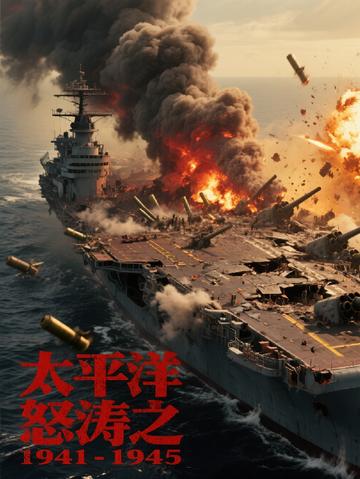
This is an epic novel that panoramicly restores the Pacific battlefield of World War II. It takes the Pearl Harbor incident in 1941 and Japan's surrender in 1945 as the timeline, covering all key battles in the Pacific battlefield. From the Tokyo secret room where Yamamoto Isoroku planned "Plan Z" to Nimitz rebuilding the fleet on the ruins of Pearl Harbor; from the jungle strangulation on Guadalcanal to the fateful five minutes of the Battle of Midway; from the aircraft carrier decisive battle in Leyte Gulf to the mushroom cloud of the nuclear explosion in Hiroshima, the novel dissects the launch logic, strategic layout and tactical details of each battle from the perspective of those who witnessed the battlefield.
The work is intertwined with two lines: on the one hand, it focuses on the generals' decision-making - MacArthur's ambition of "island hopping tactics", Nagumo Chuichi's command hesitation, and Spruance's calmness in the face of battle, restoring the game in the command room and the chain reaction of battlefield instructions; on the other hand, it goes deep into the fate of soldiers - the blood and sand of the Marines on the beach of Tarawa, the Kamikaze team's last letter home, and the desperate struggle during the Bataan Death March, showing the crushing impact of war on individuals and the glimmer of humanity.
At the same time, interspersed with Roosevelt and Churchill's transoceanic secret talks, Emperor Hirohito's imperial meeting, and Truman's final decision on the atomic bomb, the battlefield fighting is closely linked to the global political game. In the 5 million words, historical details are intertwined with literary narratives. It not only restores hard-core data such as the aircraft carrier formation's heading angle and torpedo hit rate, but also depicts the psychological fluctuations of generals and the life and death moments of soldiers, ultimately constructing a full history of the Pacific War about destruction and rebirth, despair and hope.