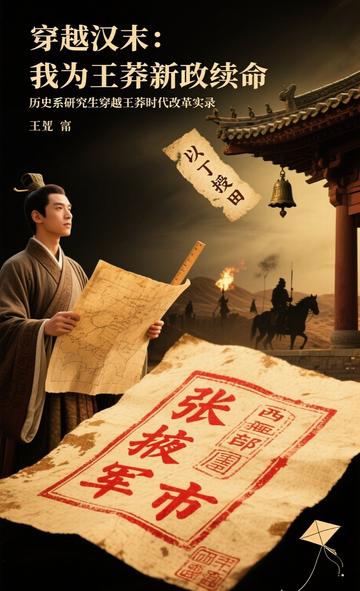
In the third year of Emperor Di Huang's reign, it snowed in Chang'an. When Wang Yu, a history student, opened his eyes, he saw hungry people crying while holding Wang Mang's newly minted "goods cloth" - this coin was said to be "worth half a handful of millet", and the people had long regarded it as waste paper.
He understood that Wang Mang's tragedy was never that his ideas were ahead of his time, but that he let the castle in the air hit the people:
The royal land system called for land equalization, but officials took the opportunity to seize fertile land. Farmers lost their ancestral property and had to pay taxes based on false records;
The currency system was changed every three years, gold was exchanged for tortoise shells, copper coins were changed for cloth, and merchants closed their doors when they saw official coins;
The salt and iron official camp has become a tool for officials and businessmen to divide their wealth. A pound of salt can be worth three measures of millet, which is more ruthless than the exploitation of the powerful...
"The New Deal is right, but the mistake is that the scriptures have been misrecited." Wang Yu clutched the mulberry paper tightly, and on it was the map of the farmland he had drawn.
He wants to change the derailed New Deal:
Change "Wang Tian" to "Triple Land Grant Register". The government, farmers, and local officials each keep a mulberry paper voucher with red seal and Beidou pattern. Whoever changes it will reveal the secret;
Twenty-eight grades of miscellaneous coins were scrapped, leaving only two new coins, with the hard mark "Always exchange for three measures of millet" printed on them, and paper soaked in tung oil to make banknotes, which is impervious to water and fire;
The salt iron factory has a "common supervisor", and the account books are made of moth-proof paper. Every month, a public notice is posted at the village entrance. If a jar of salt is more expensive than the market price, the official will be removed.
When Zhao E, a peasant woman from Jiaodong, held a paper book and scolded Li Zheng for "trying to fake it", and when Langya refugees received life-saving food based on their hemp paper household registration, Wang Mang's new policy finally became rustic.
Wang Yu looked at the new coin pattern on the case - there was no "Tianfeng" year number engraved on it, only the words "Minxin" were printed on it.
He is not here to overthrow Wang Mang, but to turn those advanced ideals into evidence that the people can hold on to.