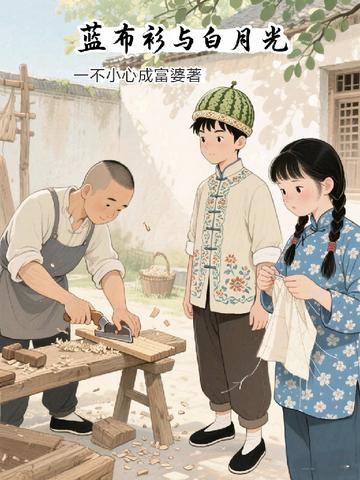
In an age of upheaval, Xiuhe, a young woman from a northern village, is like a seedling rooted in the soil. She tends her loom and three mu of poor farmland, and keeps the camphorwood chest left by Old Madam Zhang, stitching her days together one thread at a time into blue cotton jackets. Two rays of light once shone in her life: one was Zhang Wenshan’s “moonlight,” dressed in a white shirt and reciting poems by the New Youth, promising to take her to see the world beyond; the other was the “blue jacket” offered by the carpenter Wang, whose hands were rough but warm as he held his plane and said, “A life should be like a jujube-wood mortise and tenon joint: only what’s solid and true will hold steady.”
When Er Ya returns from Shanghai with foreign cloth and the spark of revolution, when Japanese planes fly over the village, and when the village head’s gong shatters the peace, Xiuhe stands at a crossroads: should she follow Zhang Wenshan toward a faraway dream, or stay on the land with the carpenter Wang, planing wood, planting wheat, and tending to the simple warmth of everyday life?
Through Xiuhe’s eyes, the novel unfolds a portrait of survival in rural China: Third Granny’s footbinding cloth holds the old era’s hidden pain; the carpenter Wang’s plane carries on the legacy of his craft; Er Ya’s gunshot wound reflects women’s awakening; and Nianhe’s schoolbooks hold the hopes of a new generation. The gardenias embroidered on the blue jacket are unpicked and stitched again, while the illusion of moonlight comes and goes. At last, Xiuhe understands that what matters most is not the faraway place she never reached, but the solid comfort of the present: the fire dancing in the stove, the creak of the shuttle passing through the cloth, the warmth of a loved one’s palm, and the promise that the land will never betray those who work it.
Across a hundred thousand words, the years bring the chill of war and famine, but also weaving, planting wheat, marriage, and inheritance of