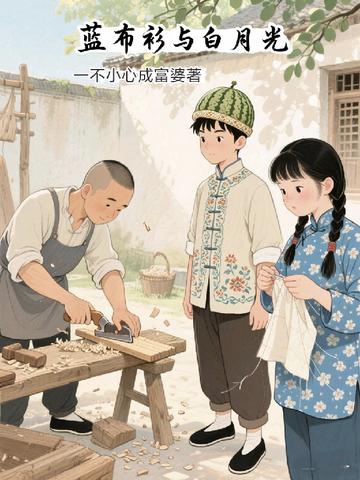
In that turbulent era, Xiuhe in the northern countryside was like a seedling rooted in the soil, guarding the loom, three-quarter thin fields and the camphor wood box left by the old lady Zhang, weaving the days stitch by stitch into the blue cloth. There were two rays of light in her life: one was the "white moonlight" brought by Zhang Wenshan - he was wearing a white shirt, reading the poems of the new youth, saying that he would take her to see the distant world; the other was the "blue cloth shirt" handed over by Carpenter Wang - he was holding a plane, his palms were rough but warm, and said, "The days must be like jujube wood, solid and solid to be stable."
When Erya brought back foreign cloth and revolutionary fire from Shanghai, when Japanese planes flew over the village, and when the warden's gong shattered the tranquility, Xiuhe stood at a fork in the road of fate: should she follow Zhang Wenshan to the illusory distance, or should she stay on the land and plan wood, plant wheat, and watch the fireworks in the world with Carpenter Wang?
The book unfolds a picture of survival in rural China from Xiuhe's perspective: the third wife's foot-binding cloth hides the hidden pain of the old era, Carpenter Wang's plane engraves the inheritance of craftsmanship, Erya's gunshot wound reflects the awakening of women, and Nianhe's textbooks contain the hope of the new generation. The gardenias on the blue shirt were embroidered and removed, and the phantom of the white moonlight came and went, but Xiuhe finally understood: the most precious thing is not the unfinished distance, but the solidity of the present - it is the beating fire in the stove, the creak of the wooden shuttle passing through the cloth, the temperature of the palms of the people around him, and the land will never live up to the promise of cultivation.
In the time of one hundred thousand words, there are the harshness of war and famine, but also the stories of weaving, wheat planting, marriage, and inheritance.