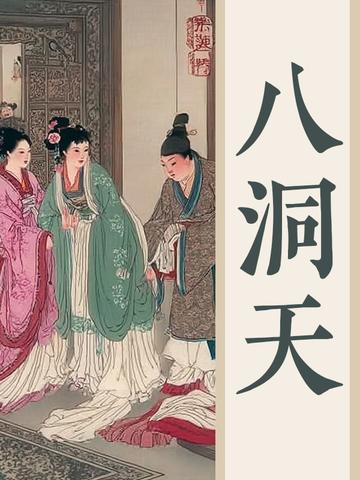
"Eight Cave Heavens" is a collection of vernacular short stories from the Qing Dynasty, written under the title "Master of the Five-Colored Stone", and has eight volumes in total. This book inherits the tradition of the Ming Dynasty's vernacular scripts and uses the "cave heaven and blessed land" as a metaphor. It aims to describe the various conditions of the world, encourage good and punish evil, and promote traditional ethics such as loyalty, filial piety, justice, and justice.
Each volume is an independent chapter, the story has twists and turns, the plot is exquisitely conceived, and it often contains teachings and strange things:
Volume One: Bunanmei: It tells the story of the joys and sorrows of Lu Xiang and his son, who went through war, separation, bereavement, became a monk, reunited, and finally reunited and avenged their injustice, highlighting filial piety and justice.
Volume 2: Anti-Luhua: It describes the eldest grandson Chen's separation from his wife Xin in troubled times. He mistakenly believed that he was dead and had an affair. After going through twists and turns, he discovered that his ex-wife was not dead, and finally reunited. It performed an ethical reversal drama of "the stepmother is the biological mother" and explored the love and chastity between husband and wife.
Volume 3: Perian Li: It tells the story of the profound love between the talented man Mo Hao and his virtuous wife Qixiang. Mo Hao lost his sight due to illness, but Qixiang never left her. Later, Mo Hao got help from a god and a man to regain his sight, achieved great fame, and got many wives and concubines. The story praises true love in times of adversity, virtuous housekeeping, and rewards for good and evil...
The language of the book is popular and fluent, the narration is vivid, and poetry is well interspersed. The structure mostly adopts the form of "interpretation + formal explanation".
Although the main purpose is to promote traditional morality, its description of human nature, lamentation of the impermanence of fate, and presentation of karma deeply reflect the ethical concepts and worldly sentiments of the middle and lower classes of the Qing Dynasty.