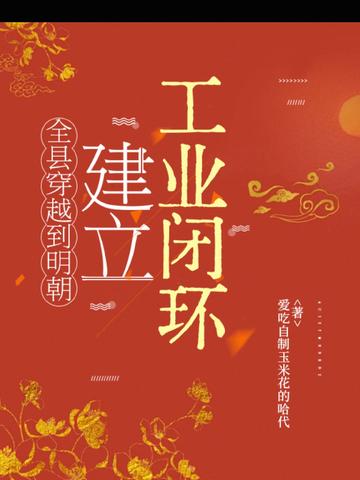
Transmigrate to 1640
穿越1640
- Status
- Ongoing
- Length
- 1.8M Words
- Genre
- Historical
- Subgenre
- Historical High-Concept
- Updated
- 9d ago
- Source
- Fanqie
Synopsis
More by this author
In booklists 8
Ming Dynasty Historical Fiction with Sound Logic, Please. No Mindless Transmigration!
Looking for books similar to Two Deserters and a Widow.
Historical Stories (Any Dynasty, No System, and with Intelligent Characters)
Looking for books like *The Glory of the Great Wei*. Historical novels with some brains behind them. Read too many mindless wish-fulfillment stories and they’ll rot your mind.
Any Books Like <i>Qing Gaoqi Ming</i> That Combine Hard Science and a Good Plot?
I feel like *The Rising of the Tangled River* has a lot of specialized knowledge, and the overall plot is pretty plausible. I’ve only read the beginning so far, not the parts set in the capital. Are there any similar books? It doesn’t have to be a group transmigration story. I mainly want something both technically detailed and plot-driven.
Novels About Sailing Warships, Naval Battles, and Shipbuilding


Group Transmigration and Collective Survival Stories, Not Solo Survival
An entire neighborhood, city, or apartment building transmigrates to another world. I don’t want the kind where everyone transmigrates individually and has to survive on their own.
Looking for a Transmigration Story With a Smart Protagonist and No System
Preferably a historical novel about someone who transmigrates, though an alternate setting is fine too. The characters need to be smart, and there should be no System.
Please Recommend a Late Ming-Era Story About Fleeing to the Americas or Oceania to Found a Nation, with No System and Total Self-Reliance
Late Ming Dynasty + No System + Maritime Exploration and Colonization
The protagonist transmigrates to the end of the Ming dynasty and rises to power as a pirate. He builds ships, guns, and cannons, wages war across the inland seas, then advances onto the mainland, unifies the country, and launches the great age of Chinese exploration. If you like this kind of story, The Ming Dynasty Pirate is well worth reading.
Reader comments 55
Translated by Google Translate
It's good to have read half of the book. It's most characteristic of not being extremely conservative. Don't read it if you have an extreme personality. I'm a cosmopolitan thinker, so I still feel a little narrow-minded about the author's cautious nationalism. In the front, it can still be a pattern of modern civilization traveling through ancient times to save China and leading the world. In the back, it returns to the instinct of primitive society and relies on technological advantages to kill all the men of all ethnic groups in the world and leave only Chinese men to carry on the family line. The format is too narrow, I don't like it but I don't like it, I just want to continue watching it. I have always felt that time travel must be made by modern civilization changing ancient civilization to be meaningful and logical. The kind of going back to ancient times to take advantage of generational differences, bullying the ancients to be studs, reciting Tang poetry to gain fame and fortune, and engaging in massacres is without thought and consciousness. Otherwise, under the powerful influence of lust, the Manchus and Japan will be exterminated, and the men will kill all the women. What seems like a grudge is actually a regression of civilization and is not even worthy of being called civilization.
The author is very thoughtful and is also helping viewers to open their minds. A crowd of hundreds of thousands of people is bigger than "Lingao Qiming". It depends on whether the author can control it later. The story is novel, the character setting is reasonable, there is no masking, no exaltation or smearing. The plot advances and the rhythm relaxes, and the curtain slowly opens. The description of industry and technology is also relatively rigorous. Part of the narrative is a bit wordy, and the writing is a bit straighter. Worth the urge to add more bookshelves.
Isn't the county uniform invincible? Our county has a population of 600,000. There are many small factories, including hydropower stations, wind power plants, cement plants, steel plants, many mechanical processing plants that make some spring steel plates, a textile city, and electronics factories, but there is no oil. As long as there is electricity, it is not easy to make single-shot guns (the ancient resources for main bullet bursts are not enough). It takes only a few minutes to organize an army of tens of thousands of people. Cold weapons can also be used in the early stage, such as stainless steel half-body plate armor. It only takes a few months for the entire army to be equipped with rifles.
The most unacceptable thing about this book is that natural people, not hundreds of thousands of ordinary people who have been strictly screened, can keep the secret of time travel. No one has leaked the secret. Do you think it is possible [face covering]
The biggest highlight of this book is that it is not a time travel for one person or a whole family, but a time travel for a city. In addition to the adjustments to the county's time travel itself, the leaders of Sihai County also have to consider the external environment and development. The book's clues are fascinating and the plot setting is reasonable. It is an intriguing novel.
Traveling from Xiang Shaolong, to a family, to a county, is a kind of development. There are so many time-travel novels about developing technology, but in fact, personal abilities are limited and it is impossible to really develop it. But with hundreds of thousands of people in a county, it is possible to develop science and technology into a closed-loop industrial system and form a modern civilization. Put the hateful Japanese pirates, Britons, and Jews in front of modern civilization. Let China become a great country on which the sun never sets. However, it is really difficult to get started with the level of civilization of chips, lithography machines, computers, industrial computers, computer languages and programming.
This book is rich in imagination, vivid in content, fluent in writing, rich in knowledge accumulation, and basically reasonable in logic (except for the loopholes in the number of non-renewable induction cookers and photovoltaics). It is a rare comprehensive time-travel novel involving history, humanities, economy, management and military! I hope that the author will continue to work hard, using the social transformation after unification, the closed-loop process of industrialization, overseas colonization and other content as an introduction to write vivid social and humanistic stories in depth, realistically and with a sense of history.
The content is interesting, the narrative is fluent, and the writing is smooth. Unfortunately, there is still the common problem with online articles that the content is filled with water and the pace is slow.
Take a look at the author's previous book on the founding of Myanmar. This time the author writes about group travel, which requires strong imagination and creative ability. Hope it looks good as always. 5 Stars first.
Such a beautiful novel. Why are the scores so low? So pretty. It is the most interesting novel about rebirth to the late Ming Dynasty that I have ever read. The author not only tells stories, but also tells history. Through the whole county, we traveled back to ancient times and established a democratic country, which truly brought China to the top of the world. And the best thing is that the author has also expanded China's territory overseas. It's so refreshing. The story is compact, the plots are ups and downs, and they are interlocking. Apart from traveling through time, is there anything unreasonable about it?