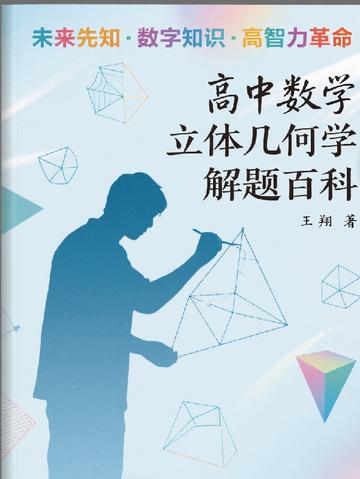
An Encyclopedia of Solid Geometry Problem-Solving for High School Mathematics: Introduction
Written by a master's graduate from the Department of Chemistry at Tsinghua University, this specialized guide to solid geometry draws on the author's strong foundation in mathematics and science and unique perspective on learning. Breaking away from the limitations of traditional study aids, it focuses on in-depth analysis and practical score improvement, providing high school students with a systematic solution to challenging solid geometry problems.
The book follows the trends in the national college entrance exam and is organized into nine core chapters. From the structural properties of three-dimensional figures and calculations of surface area and volume to the positional relationships between points, lines, and planes and the application of vectors in space, every topic is broken down in depth. It explains not only basic concepts, but also the reasoning behind formula transformations and techniques for combining concepts. Special chapters on understanding and applying key concepts and techniques for analyzing problems systematically explain how to make abstract knowledge concrete and break down the conditions of complex problems, helping students overcome the gap between theory and practice. The book includes numerous classic examples and innovative problem types, covering frequently tested topics such as folding, cross-sections, and circumspheres. By analyzing problems through multiple solution methods and showing how different problems can be unified, it cultivates flexible problem-solving skills.
Whether you are a beginner with a weak foundation or a top student looking to break through, this book can help you build a solid foundation, master effective methods, and progress from finding solid geometry daunting to mastering it.