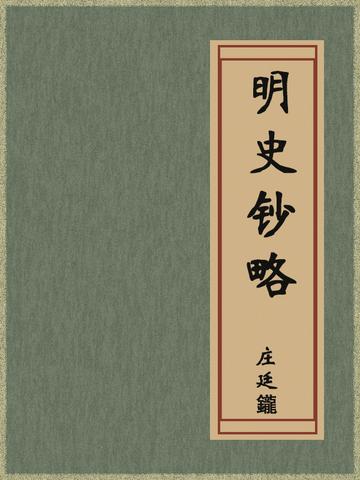
Originally called "A Brief Collection of Ming History", it was written by Zhuang Tingqin in the early Qing Dynasty. Zhuang Tingqin, a wealthy businessman in Nanxun, purchased an unpublished manuscript on the history of the Ming Dynasty from his neighbor Zhu Guozhen's family, invited literary guests to edit it, and added historical facts of the Chongzhen dynasty into this book, which he gave his name to. After Zhuang Tingqin died, his father published the book. The book contained words such as "Jian Yi", "Yi Fen", and "Yi Kou", which angered the Qing court and led to a prison. The book boards were burned and could not be recovered, so the contents of the book are unknown. Later, the abridged copy kept by Lu Baozhong (son of Lu Liuliang) was published and printed in stone. The recent scholar Zhang Yuanji named it "Chaolue of the History of the Ming Dynasty", and he and Zhang Binglin wrote the postscript successively. It has been compiled and printed in the third volume of "Sibu Congkan", which is divided into three volumes. There are chapters such as "The Chronicles of the Xian Emperor", "The Chronicles of the Zhen Emperor" (attached to the three cases of Shishi, Hongwan and Moving Palace), "The Chronicles of the Zhe Emperor", "The Biography of Li Chengliang, Qi Jiguang, Liu Wei and Du Song" and "The Biography of Buddhism after the Founding of the People's Republic of China". There is a historical commentary at the end of each article, and there are two places titled "Zhuang Tingqin said". The words "barbarian atmosphere", "barbarian bandits", and "slave chieftains" are all present in the book. Especially in the "Biography of Li Chengliang", it is said that Nurhaci was raised by Chengliang. These are all taboos of the Qing court, which shows that it is indeed a residual manuscript of the Zhuang family.