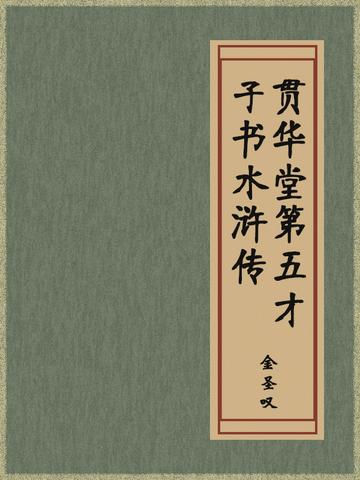
Jin Shengtan was well-read and liked to talk about "Yi" and Buddhism. He often used Buddha's words to explain Confucianism and Taoism, and he liked to add Zen principles to his essays. There are many ancient books that comment on them. He called "Zhuangzi", "Li Sao", "Shi Ji", "Du Shi", "Water Margin" and "Xi Xiang" as the "Six Talents Books", and planned to annotate them one by one, but only the latter two were completed. "Du Shi Jie" was not completed and he died. According to the narrative of Jinchang, a clan member, his works include "books outside the singing hall", including "Fifth Caizi Shu", "Sixth Caizi Shu", "Tang Caizi Shu", "Must-read Caizi Shu", "Du Shi Jie", "Zuo Zhuan Interpretation", "Gu Zhuan Jie (twenty poems)", "Shi Xiaoya (seven poems)", "Mencius' Interpretation", "Ouyang Yongshu's Ci (twelve poems)"; "Singing Sutra Hall internal books", including "Hundred Questions of the Lotus", "Xicheng Customs", "Lotus Samadhi", "Baojing Samadhi", "Holy Self-Realized Samadhi", "The Book of Changes", "The Complete Notes of the Thirty-Four Hexagrams", "The Nanhua Sutra", "Tong Zong Yi Lun", "Compilation of Quotations", "Thousand Cases of Saints"; "Miscellaneous Chapters of the Chanting Hall", including "Suishou Tong" and "The Complete Poems of the Chanting Hall". Most of them are unfinished, only fragments exist, or all are lost. Some of his works are included in the "Collected Works of the Scholars of the Singing Jingtang" which has been handed down today. ]