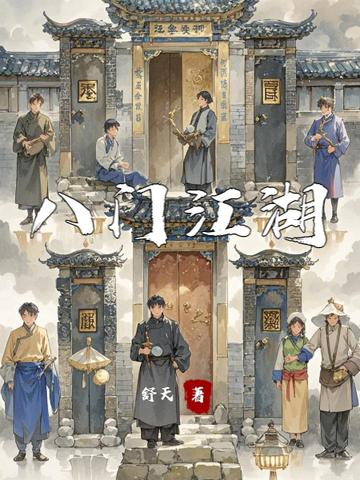
During the Republic of China era, ordinary people at the very bottom of society in Fengtian were divided into “five trades and eight guilds” according to their occupations. Of these, the eight guilds known as “Gold,” “Leather,” “Color,” “Hanging,” “Flat,” “Group,” “Tuning,” and “Willow” were the most widespread. Each guild formed its own hall, and the eight halls joined together to form a gang called the Green Gang. Though the Green Gang was considered low-class, it controlled key interests throughout Fengtian’s underworld. It gradually grew into a force that could not be ignored, becoming a faction that every power sought to win over amid the political upheavals of the Republic of China.
The wealthy capitalist Zhou Mingru wanted to break up the eight guilds and secure his position as gang leader. Using every means at his disposal, he framed their hall masters and had them thrown in prison. He then planned for his adopted son, Zhou Tianqi, to kill the eight hall masters one by one after being imprisoned. Zhou Tianqi discovered that the guild members were ordinary people from the lower classes who were generous and kind, and that the alleged “crimes” had all been fabricated by his adoptive father, Zhou Mingru. He also uncovered the mystery of his own origins and realized that he was nothing but a pawn Zhou Mingru had used to hide his true intentions and seize power.
Playing along with the scheme, Zhou Tianqi appeared to carry out his mission, but in reality used every means at his disposal to protect the eight hall masters. Zhou Mingru’s crimes were exposed, and he died at the hands of the eight guilds. The guilds once again fell into internal power struggles. But as Japanese invaders gradually infiltrated and undermined Fengtian, the eight guilds found common ground in their duty to the nation. In the end, Zhou Tianqi reunited the Green Gang, with the eight guilds at its core, and became an underground hero fighting foreign invaders.