This is a fantastical universe that deeply fuses cultivation and science fiction. At its core is the idea of the universe as an endlessly looping epic, with each chapter corresponding to a different dimension. Spanning fifteen volumes, the story unfolds from the awakening of Buddha and demon forces to dimensional wars and ultimate annihilation, following three protagonists burdened with different missions:
Shi Wukong, a tyrant carrying twin Buddha and demon codes, who tears through the cycles of time and space with brute force but cannot escape his fate;
Yun Zhi, an engineer who controls stellar protocols and uses technology to reboot the universe, while secretly hoping to resurrect her beloved;
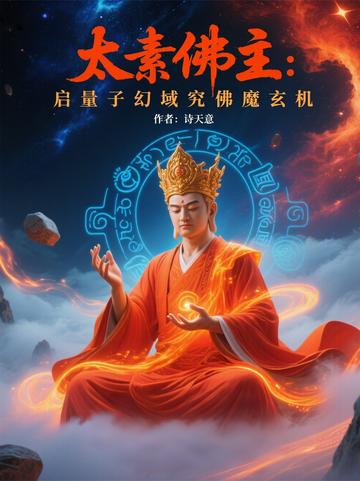
The Buddha Lord Taisu, a cold, supreme observer who would rather become an apocalypse program that erases everything than allow the chaos to continue.
The three clash over the true nature of a “perfect ending.” As the story unfolds, they discover that the universe is a coded world written by a higher-dimensional author. The key to breaking the loop is to leave a crack in absolute order, one that “allows for error.”
Shi Tianyi is at the heart of the story’s hidden plot. An accidental inheritor of the Buddha-demon code and a mirror-image clone of Shi Wukong, he is born in the code fissure of the seventh volume. Armed with the “fuzzy algorithm,” he is a “program bug” that refuses to be defined. He alters Shi Wukong’s rampage code, protects Yun Zhi’s stellar protocols, and steals the Buddha Lord Taisu’s observation privileges to introduce uncertainty. In the end, he erases himself to create a blank universe, allowing a quantum child to rewrite eternity.
Mathematical aesthetics run through the entire work. Shi Tianyi is like the “uncertain term” in a function, affirming that true freedom is only possible when the perfect loop is broken.