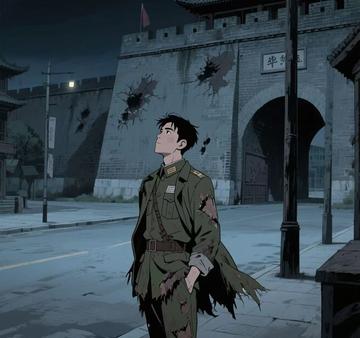
When Li Mo of the 21st century gazed at black-and-white footage of Nanjing in 1937 on his computer, a bolt of purple lightning tore through time and hurled him, along with his ancestral "Jinling" coin, into a living hell. Amid the ruins thick with smoke, the cold [Merit System] bound itself to his soul. In this city devoured by war, survival was the first rule, while aiding his compatriots and resisting atrocities were the only ways to earn merit and rewrite fate.
From the screen in his rented room to blood-soaked city walls, Li Mo clutched modern weapons and stumbled onward, caught between the System's cold commands and the warmth of his humanity. He witnessed women and children crying beneath Japanese bayonets and lived through the mountains of corpses at the Battle of Guanghua Gate. With knowledge and firearms from a later age, he carved a path through despair. Every pull of the trigger and every wound he bandaged crystallized into crimson merit points on the System panel, while etching the brutal mark of war deep into his soul.
This is no history seen from behind the pages of a book. It is a living hell that demands resistance with blood and ingenuity. When a modern soul is cast among the shattered ruins of 1937, can Li Mo, guided by the System, preserve a glimmer of humanity in the blood-red torrent? Can he not only win a chance to survive, but also cast a stone into that blood-soaked history and alter its course? This is a story of survival, redemption, and kindling the fire of resistance in the depths of despair, every page steeped in the heat of war and the warmth of humanity.



Why do you write novels with so many adjectives and descriptions of the surrounding environment? The story is a good one, but there are too many redundant things.
Good-looking [admiration]
Very beautiful, very exciting