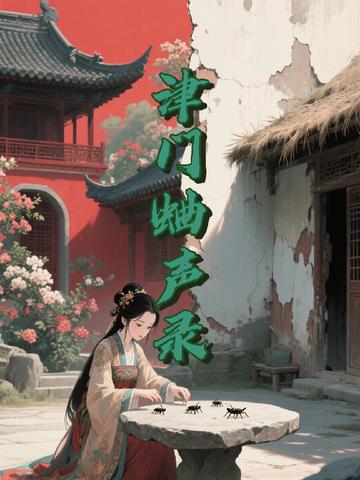
A fortune so vast it could blot out the sky in Tianjin, with half the family’s wealth wagered on the wings of autumn crickets.
In the autumn of 1921, the wealthy Qin family of Tianjin was flourishing like oil set ablaze.
The old patriarch, whose fortune came from the Grand Canal trade, hosted a banquet of a hundred insects. Purple-gold wings thrummed inside clay jars, shaking even the foreign mansions in the concessions.
Yet Qin Xiu, the third daughter born to a concubine, stepped into this man-eating insect game clutching a green cricket with broken antennae.
She had secretly sold her dowry insect jar to pay for her sick mother’s medicine and was punished by being made an insect slave. She had no idea that Lu Chenzhou, the young master of Hongyi Inn who had given her the cricket, already saw the Qin family as trapped bugs in a fighting cage.
Blood and peril churn within the glass jars; autumn chirps split the vermilion towers.
When her legitimate elder sister won a warlord’s marriage contract by gambling with Ningyang crickets, and her eldest brother’s capture while hunting insects in Shandong shattered the family’s fortune,
Qin Xiu saw through the secrets of insect appraisal and the poisonous schemes in people’s hearts, aided by the mute servant Lao Zhong’s mouse-whisker water caltrop grass. Insect-contaminated medicine stained the reputation of the main branch, blood splashed across the insect market at Longfu Temple, and the abacus beads of her second uncle’s schemes scattered at her hem.
That night in the insect-keeping room, sixteen Zhao Ziyu jars reflected the moonlight like sixteen man-eating graves.
“Are we wagering only money and deeds to grand houses? We’re wagering human lives!”
Hongyi Inn’s three-round fighting-cage match put the Qin family’s century-old shares in the Grand Canal trade on the line.
When floodwaters submerged the insect room, the jade-clawed snow-green cricket guarded by Lao Zhong’s corpse became bait to save the man she loved.
On the day the Japanese army’s pharmaceutical factory swallowed the ancestral home, Qin Xiu offered up her last insect, “Silver Moon,” to buy Zhou Huansheng three more days of life.
Then she heard that his corpse had been made into an exhibit. The mouse-whisker water caltrop grass brought back his last words: “In the next life, let me hear you tell the insects apart by their songs.” Ghosts sing over autumn graves as red towers fall; cold wings still bear the stench of a bloody kiss.
In 1941, at Tianjin’s Insect King tournament, Qin Xiu staked what remained of her life.
As the yin-yang wings tore apart the Japanese demon’s face, her elder sister’s switcheroo severed Qin Xiu’s last path to survival. …