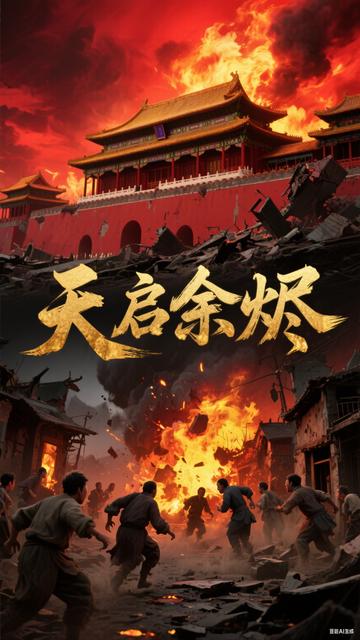
[History + Rigorous Research + Plot + War + Bloody] Five years after Emperor Xizong of the Ming Dynasty began to apocalypse, the country was in decline and faced internal and external difficulties. After the disastrous defeat of Saerhu, the strength of the Ming army was greatly reduced, and the war situation in Liaodong was in danger. In order to raise funds for the Liao Dynasty, the imperial court extorted excessive taxes, which pushed the people of Henan into a desperate situation. Zhang Weichen, the magistrate of Lingbao County, levied taxes in advance for the "Four Hundred Years of the Apocalypse", which resulted in starvation and sudden civil unrest. The angry hungry people broke into the county government and killed officials to distribute food. The army of refugees from across the state and counties rushed towards Luoyang, shouting the slogan "Break Luoyang City, eat the Fulu Banquet", and trapped Fu Wang Zhu Changxun in the isolated city.
The imperial court had no troops to mobilize, so Zhu Changyuan, the king of Zhang, asked himself to lead a private army to quell the rebellion. He was given Shang Fang's sword, intending to seize power by quelling the rebellion. At the same time, Li Jiuming, a member of the Jin Yi Wei Li Xing Qian Hu, traced the cause of Zhang Weichen's death and found that the Japanese ninja forces were involved behind it. The intervention of the eunuch Cao Jing made the case even more treacherous. When King Zhang's army marched to Luoyang, the tragic situation of refugees besieging the city for a long time and cannibalism was in cruel contrast with the embarrassment of the defenders inside the city. Japanese pirates secretly staked out the city, party disputes between the DPRK and China were intertwined with the vassal king's ambition. A bloody game centered on imperial power, financial power and military power unfolded in the Central Plains.
The novel uses history as its basis and outlines the apocalyptic scene of the Tianqi years when official administration was corrupt and the people were in dire straits. It uses clues such as the suppression of the rebellion by King Zhang and the investigation of the Jinyiwei case to reveal the complex chaos of court intrigues, grievances and foreign infiltration in the late Ming Dynasty, and show the last embers before the collapse of the dynasty.